
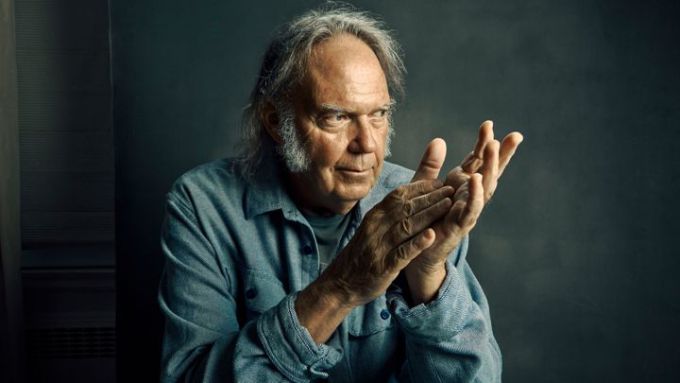
By Harry Myles, Feature Photo via Rolling Stone//taken by Matt Furman
Earth may be the most Neil Young album ever produced. Released as a continuous 98-minute track, Earth features 13 songs from Young’s recent 2015 tour with backing band Promise of the Real (led by Willie Nelson’s sons, Lukas and Micah) and spans his entire career. This includes“Human Highway,” originally found on 1978’s Comes A Time, to the recent 2015 “Big Box” of The Monsanto Years. Bizarre, thematic, and incredibly spiteful, this latest release seems to encompass the very soul of the artist.
The album continues Young’s assault upon mp3s, being exclusively available on Pono Music (his overpriced hi-fidelity audio player) and Tidal (the only streaming service that “can handle [Earth]”). Only these digital formats, according to Young, can provide a high quality, lossless experience that can capture the power of a live performance. This kind of power is further evident in Young’s protest throughout the album.
From his protest against several capitalistic agencies including agricultural giant Monsanto (a corporation synonymous with GMOs) to big box stores, greedy oil companies, and of course the many other villains of Mother Nature. To do this, Earth employs animal noises to accent the ecological theme and further enhance the artist’s lyrical activism.

For many, Earth may seem like the latest in a series of peculiar agriculturally focused albums Young has released over the past ten years. However, instead the record provides some form of cohesion and order to the chaos of his recent discography. Earth appears to be the summary of his life’s work as he delivers a series of songs from across his career centered upon a distinct message. Since the 1970s, Young has passionately supported ecological awareness and has only become more vocal as the decades passed; now this latest release is his conclusive statement drawn from over 30 years of material. Additionally, with Earth he attempts to revolutionize the live album. Rather than include the characteristic applause and hollers of a traditional live release, Young instead overlays various animal and insect sounds across every song. The buzz of a bee and whinnying of a horse replaces the cheers of a human crowd, creating the illusion as Young describes it of “all the living things of Earth [being] in the audience”. Musically, the songs are only slightly adjusted from their originals, however the true achievement of Earth is its “natural” production that presents an album deserving of its title.
Before the first song, thunder cracks in the distance and a subtle rain begins to fall, followed shortly thereafter by the croak of a chorus of frogs. Orchestral harmonica soon interrupts and “Mother Earth” begins as a distinct introduction to the album. Appearing on several tracks, harmonious background vocals accompany the whine of Young’s voice as he speaks of Mother Earth’s “fields of green” and softly dispels his ecological lesson. Ending in a cacophony of bees, the album begins to gain speed as a raucous electric guitar introduces “Seed Justice” and continues to drive each additional song. “The Monsanto Years”, “Vampire Blues”, and “Hippie Dream” are complemented by Young’s signature riffs as he becomes increasingly aggressive. Denouncing Monsanto, condemning the oil corporations that suck “blood from the earth”, and dreaming of a long-gone world of environmental harmony, Young’s anger emphasizes every line and persists until the completion of the final song, a 28-minute rendition of “Love and Only Love” filled with tiring guitar solos and pounding percussion. Save for the calm of “After the Gold Rush”, every song reminds the audience of Young’s intentions and successfully captures the frustration of the artist.
While some may dismiss them as ridiculous, I personally enjoyed the added animals and their ability to enhance the music. A dog barks and a rooster crows, conjuring the image of a rural farm in “My Country Home”. A bell tolls and a crow calls in the finale of “Monsanto Years”, ominously implying an end of days unless agribusiness can be controlled. (I like this.) The noises are perfectly incorporated into every track and demonstrate an incredible achievement of production. At times, this masterful inclusion of additional sounds is interrupted by an odd use of excessive auto tune, as Young often resembles an agriculturally aware cyborg while singing “GMO”. Overall however, Earth is one of Neil Young’s most interesting albums in the past couple years, providing the listener with a unique musical experience that may be odd, but nonetheless impressive. (Warner Bros.)







 Demo Magazine
Leave a comment