
Photos by Abigail Heron
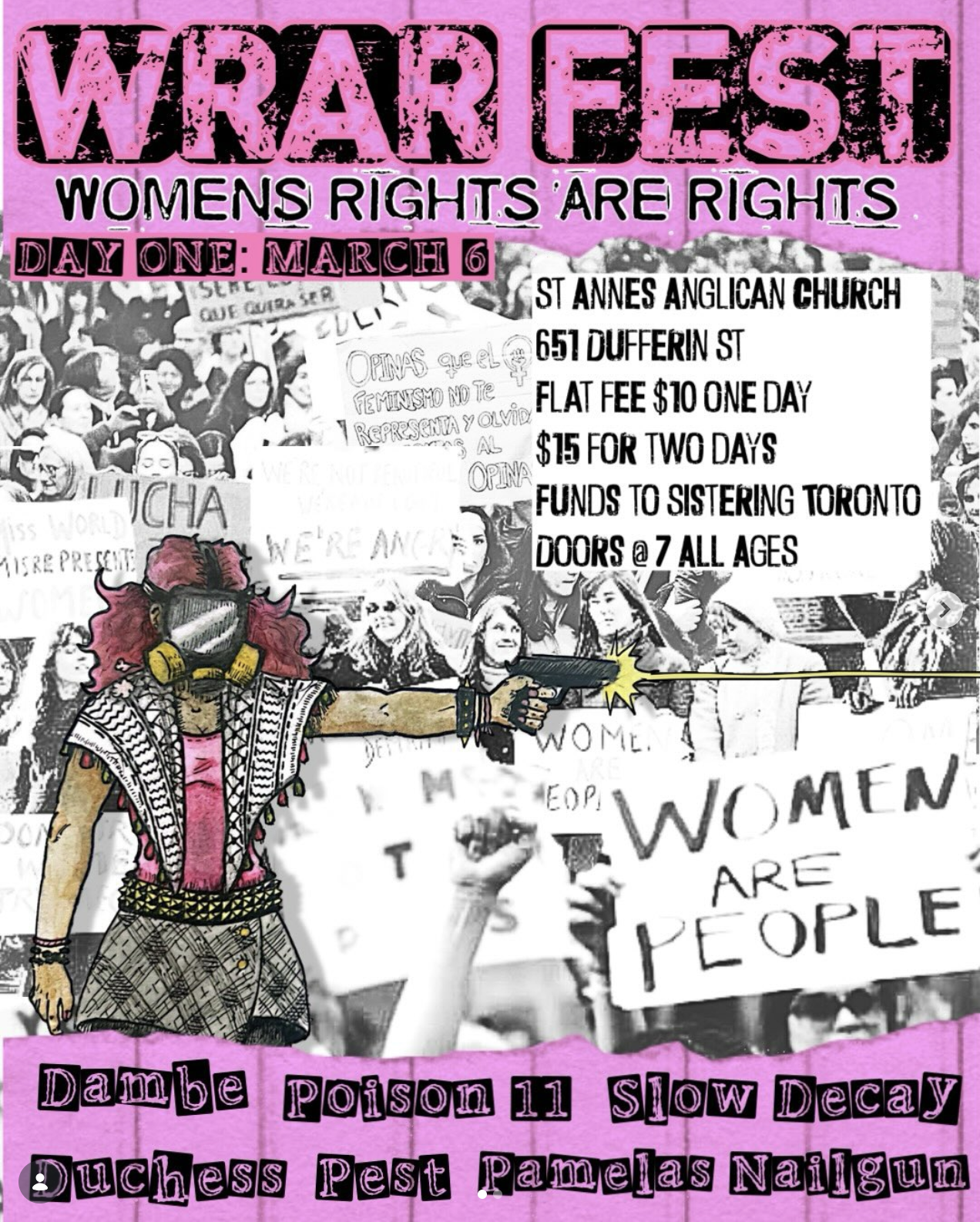
The Toronto Transit Commission was definitely not respecting women’s rights on March 6th, 2026. Various closed transit lines right when we needed it most, and heavy rain caused my friend and I to run frantically to St. Anne’s Anglican Church for the Women’s Rights Are Rights (WRAR) Fest. This year, WRAR Fest happened over two days with bills of six bands each night. Following the success of the previous year, all proceeds went to Sistering and EmpowerHER Congo. It wasn’t to be missed!.
We made it to the entrance just as Pamela’s Nailgun started playing. Drenched, slightly muddy, mascara running, and very tired, we reached into our pockets for cash, barely having the energy to open our mouths. The girl at the door watched us slosh towards her, eyes darting between my friend and I, “Hello?” she asked, but before we could answer she sternly said, “Closed mouths don’t get fed babes!” This perked me up. We handed her the cash, mumbled a few sorry’s and rushed down the dampened stairs of the church to the basement where cheers rumbled through the old building.
Humid air immediately hit us like a wall. The turnout was huge–crowds of people circled around the stage and its periphery, and the venue was dotted with vendors selling handmade goods, zines, pins, and clothing for various causes. The fashion at this show was definitely noteworthy. I’d really like to highlight how stylish everyone was. The looks ranged from all-white linen, Victorian gothic and mall punk, to old-school rock, metal, and even business casual. WRAR Fest felt distinct from a lot of other events I’ve been to, and perhaps it’s because of this audience. St. Anne’s as a venue is quite particular about their events being open to all ages, meaning that the audience at their shows tend to be quite young. And I mean young, because I hear a group maniacally yell “6-7” somewhere.
While these observations were taking place, Pamela’s Nailgun had been ripping through their set. Having formed quite recently, the lead singer enthusiastically let us know that it’s their first show ever. Their music is self-described as post-hardcore and mathcore. Some of the members are even the acquaintances of several UofT students! The vocalist’s screams ripped through the frenzied crowd with a sharp crack. The guitarist bent and stretched with their riffs. Everyone loved it, and they ended on a strong note. Though I didn’t get a chance to hear what the names of their songs were, I’m really excited to see how the band evolves.

During the break, I took the opportunity to speak with a few people around me.
UM: “So, how do you feel about women’s rights?”
Audience Member: “They’re cool.”
Though absolutely correct, I also spoke to one of the vendors hoping for a more elaborate answer. Julianne, who runs Dead Mail Zine and is also a UofT alumna (!), writes extensively about social justice, politics, and music. We had a pleasant conversation, and Julianne enlightened me on the inner workings of the punk scene. Despite its foundations of countering the zeitgeist, punk is overcharacterized by male whiteness with minimal attention being given to women, the POC, and the queer communities that have carried the movement since its start. By definition, this characterization is not punk. Punk is marginalized, punk is anti-establishment, punk is non-conformist, and it goes against the standard. For this reason, WRAR Fest’s existence is crucial because it creates a space specifically designated for the celebration of women.
Like clockwork, the “filthiest band on the planet” slow decay started their set with a mantra: “WOMEN ARE AWESOME!” Hell yeah. slow decay was visually striking, and everybody else seemed to have been aware of this fact because the entire front row became crowded with photographers.Their lead singer had dressed as John Waters, and the other members were adorned in doll-like dresses, kinked hair, and porcelain makeup. Something felt very dystopian about this ensemble, as their vivid aesthetic became quickly engulfed in the harsh white flashes of cameras. They played their first song; it’s about periods. The music was dissonant and psychedelic, but became sharply focused in moments of what I would describe as frustration and female rage. The vocalist’s voice was sweet and faraway one moment, then suddenly snapped into a fury the next. This was just about as accurate as you can get to capturing the experience of girlhood. The next song “[A Sheppard] Without His Sheep,” was of a similar discordant nature, and a pit formed in response. The third song “Albatross” was my personal favorite. It was melodic, wispy, and so very moody. The lyrics included the word “never” being wept repeatedly and ominously. The mosh pit that had been circling deliriously before suddenly stopped and everyone in the crowd began to sway like blades of grass on a summer evening. Then it all crumbled down at the fourth song, “Jellybean”, which had a classic garage punk sound. Finally, slow decay played “Piggy Parade;” it’s about all the pigs on the street, if you know what I mean.

Next up was PEST, whose sound was unequivocally hardcore. Their songs had an equally feminist rhetoric as slow decay, but their lyricism was much more explicit. Take their third song, “For Justice and Peace,” about a 16 year old girl who was sexually assaulted and underwent an abortion. Their music brought a much needed edge to WRAR Fest in discussing topics of human rights in excruciating detail, considering current events, and figures in power. A lump formed in my throat listening to the animalistic grief of PEST’s set.

Afterwards, POISON 11 took to the stage. Their sound was so heavy, and the ensuing moshpit so terrifying that I retreated to the side. The building quite literally shook in response. Though their songs were untitled, before each piece the vocalist gave a passionate speech about civil rights, about loving all women, about admonishing pedophiles, about not touching people without their consent, and also lucha libre. Two of the band’s members were wearing Mexican wrestling masks and ended the set with a KO scene. Person after person surfed the crowd and the energy was at an all-time high.

At this point, the exhaustion was beginning to set in. Not for long, though, because Duchess was up next. This was my second time seeing them live, and at St. Anne’s no less. The moment they stepped on the stage to set up, comments flew about their fits. Duchess is known for being very well dressed, particularly in a manner that encapsulates their name with an alternative aptitude. They were adorned in frocks and feathers, tiaras and lace, but also leather. Their faces were powdered but their eyeliner ran. It’s like they’re from a time and land of duchesses, appropriately fancy and regal, but also frighteningly raunchy and real. The look was only complete with their winding music, folk vocals, and whining guitar. The set started with a passage from the Bible, though I couldn’t make out which part. Abruptly, the vocalist screamed with what I can only describe as hatred, “Fuck ICE!,” then she flitted and floated to the music. The crowd couldn’t get enough of it. Towards the end of their set, she stepped into the pit and parted it like the Red Sea. The stage presence and the aura of Duchess never ceases to amaze me. Though their overall music is very similar to other punk, riot, and groove performers, their artistic execution continually makes them stand out. In my mind, their visage is forever embedded as an afterimage in front of that white brick wall at St. Anne’s.

At this point, the show had been going on for almost five hours, yet the headcount hadn’t waned a single bit. Before I could even check which band would end the night, the crowd started chanting “DAMBE! DAMBE! DAMBE!” Everyone had been waiting for this. DAMBE stepped out, quietly picked up their instruments, and then the hardcore onslaught began. Their music was so guttural and so fucking good that it actually scared the shit out of me. My friend and I slowly turned towards each other, jaws on the floor, and ran straight for the pit. The crowd was going insane. Experiencing DAMBE is cathartic: you weave in and out of that mass as if you were being birthed over and over again. But more so than that, it was refreshing to see a punk ensemble made up entirely of POC. While Toronto’s scene is becoming more diverse, it was powerful to see Black musicians take up space, front a band, and lead the way. Their performance clearly connected with the crowd on a deeper level, and the community felt complete.

Overall, WRAR Fest holds a special place in the community and my heart. It allows for the congregation of youth who love punk and alternative music, as well as the open discussion, support for, and celebration of women’s rights, efforts, and struggles. These conversations are so important for developing understanding, empathy, and civil liberty in our community. My friend, who came to Toronto from Thunder Bay, directly expressed sentiments that such opportunities were rare or even nonexistent back home, and how lucky the youth of Toronto must be to get to experience this. Even if some only attended WRAR Fest for the music or the moshing, it is without a doubt that they left with a new comprehension of women’s rights, social justice, and acceptance. With this sentiment we sauntered back up the creaking steps of St. Anne’s and embarked on the journey home. I hope that those old stairs continue to survive and support the next event, and the next after that.


Leave a Reply