
Welcome to the first instalment of a series that I, Sascha Pugar, will be hosting, where I write a detailed review of my favourite album that I discovered every month! As someone who listens to an absurd amount of music (approximately 2000 new albums every year), I feel that it is my duty to share with the world the music that I find to be the most important.
Our innate desire to create systems of categorization has pushed humanity forward through the organization of just about everything. Simple standardization of terms has brought the sciences to where they are today, helping us discuss any scientific concept with objectivity. A problem arises when you begin to look at the ever-increasing granularity of your terms. The edge cases begin to pile up, and next thing you know you’re categorizing a table as a type of chair (has legs, can be sat on), and vice versa. In the arts, this same sort of problem comes to light when trying to define the dates associated with various genres. Musical scenes are a bit easier to track because they are explicitly linked to a specific time and place, but even then it can quickly become confusing. Who started the legendary New York CBGB punk Scene? Was it Patti Smith or Television? Good luck trying to figure out larger genres like punk or R&B, as it’s practically impossible to attribute said styles to one singular person, place, or time. The ambiguity makes not only the history more interesting, but also the artists themselves. It’s fascinating to think that across the world multiple people were bringing the same ideas to life at roughly the same time, only for a bunch of internet comment sections to argue about who did it first.
The 2000s were the Wild West when it came to attempting to recycle musical ideas from the past. In the fringe, experimental corners of the medium, people were fragmenting different musical tropes and trying to stitch them back together to create something new. The genre of vaporwave, which started sometime at the end of the 2000s, and the very hazily defined “hypnagogic pop” which began in the same decade, both reflected a growing uncertainty with music. To artists like James Ferraro and Daniel Lopatin, all of the building blocks to create interesting music had already been solidified, but something unexplainable was still missing. These artists were using low-fidelity sound equipment, odd combinations of instruments and production software, and a ridiculously diverse array of material to sample. The result was music that broke any former understanding of what the medium can be and the rules that apply.
These styles coat their repetitive samples in a mysterious but ethereal aesthetic that is difficult to pin down. Ferraro’s 2008 album Marble Surf sounds like a biblically accurate depiction of heaven–overwhelming and somewhat intangible. Lopatin’s Chuck Person’s Eccojams from 2010 sounds like the process of trying to recover deep memories. The album is almost occupying a surreal space that, as soon as you think you have a full grasp on it, whiplashes into a new broken memory, repeating the process. There is one glaring detail of these works and many others of the time: the intentionality behind their creation. This was an unexplored niche that many clever minds were trying to fill, but what happens when this process is discovered by accident?
Bull of Heaven was a very experimental music duo formed in 2008 by Neil Keener and Clayton Counts. They originally began making drone music in the laziest way possible: Take a few samples and stretch them out until they are unrecognizable, maybe throw in a few loops and effects, and boom, it’s done. This allowed them to pump out dozens of projects within their first couple months as a band. One goal of theirs as they kept churning out albums was to play around with a property of music that they felt people took for granted: time. In the digital age of releasing music as files, they found workarounds that would allow their music to compress into ZIP files, making their samples last essentially as long as they wanted. This resulted in some albums of theirs hitting ridiculous play times, the most well known example being Like a Wall in Which an Insect Lives and Gnaws, coming in at 9060 hours long. It was a thought experiment which frankly sounded terrible when actually listened to. It was clearly intended as an art project instead of actual musical output, occupying nothing more than fun music trivia in retrospect.
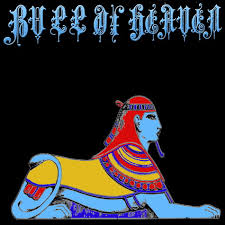
Strangely enough, before the advent of vaporwave as a common term to use in around 2011, Keener and Counts created one specific drone release that would completely shift their reputation away from being nothing but a “meme band.” Their 29th album, titled Lions on a Banner from early 2008 is, simply put, one of the most gorgeous pieces of ambient music I have ever heard. The cover art shows nothing more than the name of the band and a picture of an Egyptian sphinx, drawn in the style of an old PC game. The odd colour palette of the cover art matches the music perfectly, as this work is extremely difficult to describe. There is an alien-like quality to the sound, where it can chameleon itself into whatever emotion you wish to feel. As the samples begin to layer over each other and slowly fade in and out of occasional climaxes, it creates a feeling that overwhelms, evoking almost a dreadful realization of one’s loneliness. It feels akin to Ferraro’s work. The repetition and stability of form reads off as deeply meditative, creating a trance-like state that is commonly seen in traditional ambient music. The low-fidelity of the samples creates feelings of nostalgia, which is similar to what can be found in the Vaporwave movement started by Lopatin. This album is really strange in the way it can drag you into whichever corner of your mind you wish to occupy. There’s something deeply spiritual in that process, almost like the choice of an Ancient Egyptian aesthetic was fully intentional.
This album was clearly an accident, though. Bull of Heaven would release their albums in specific aesthetic batches–the two albums that sandwich this one have similar palettes of sound, but are missing the deeply spiritual, liminal pull of Lions on a Banner. After these releases, they would continue switching between incredibly boring drone albums and extremely long releases which were essentially coding projects. Everything about Lions on a Banner is a sheer anomaly, and predates a lot of the work that is pivotal to this sound. James Ferraro was around before this group, but pretty much anything else in this genre would follow suit a few years later.
That brings me to this album’s postmodern quality. The lack of discernible emotion the sound possesses challenges one’s understanding of how to interpret music. Naturally, we all take away something different from an album based upon our lived experiences. However, when a work itself is so confused that it can adapt to the experience of the listener without having any grounding ideas in its sonic aesthetic, it makes any semblance of objectivity fall out of the window. This album isn’t saying anything, but says so much in its lack of clear direction.
Bull of Heaven buried this album among dozens of others because it didn’t mean anything to them. It slowly drifted away into the corners of the internet, no different than the corners of my mind it somehow unlocks. This album is almost authorless, because if Bull of Heaven never existed, Lions on a Banner probably would have been created anyways. Their music is like the idea that a monkey can be sat in front of a typewriter for eternity and it will eventually write the entirety of Shakespeare’s Hamlet, despite the monkey having no intentionality in its actions. Lions on a Banner is simply a culmination of the internet’s vastness, and a testament to the eventual beauty that can be created if you give infinity its time.
David Bowie discussed the internet in an interview in 1999–well before these styles of music were even a thought–stating that the internet would change the context and the state of content in ways that are both exhilarating and terrifying. Lions on a Banner can sound both exhilarating and terrifying, and because it is an entirely sampled work, it relies on pre-existing content. David Bowie was not a time traveller–the trajectory of 2000s recontextualization through music was inevitable. This album is brilliant and moves me deeply, not because it tries to, but because it would have happened anyways as long as I kept looking.


Leave a Reply