
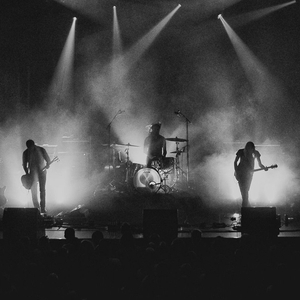
Image credit: https://www.bandsintown.com/e/108573788-russian-circles-at-the-opera-house
On a warm September night that still clung to the last remnants of summer, I joined a large crowd at the Opera House to see Pelican and Russian Circles perform. A combined show of these two bands was an instrumental post-metal fan’s dream. I started listening to them in my first year of undergrad, with their music providing the soundtrack for countless study sessions. Whenever I hear their music now, I think of studying, or fret about the work I have to do.
Pelican and Russian Circles both formed in Chicago in the early 2000s. Pelican is a four-piece comprised of Trevor de Brauw on guitar, Laurent Schroeder-Lebec on guitar, Bryan Herweg on bass, and Larry Herweg on drums, although their lineup has gone through some changes over the years. They have released seven studio albums and six EPs over their two-decade history. Pelican’s music could be classified under multiple genres, ranging from progressive rock to post-metal. This is deliberate: the band aims to avoid being constrained by a single genre which could limit their sound. Russian Circles was named after an ice hockey drill that childhood best friends Mike Sullivan (guitar) and Dave Turncratz (drums) grew up doing together. The trio was rounded out by Brian Cook on bass after original member Colin DeKuiper left in 2007. With two EPs and nine studio albums, their sound has remained consistent throughout, and centers around instrumental post-metal.
Despite forming around the same time and being firmly in the post-metal genre, the two bands have distinct sounds. Pelican tends to skew more toward progressive rock, with their songs switching between resonant heavy riffs and light, poetic breakdowns. Russian Circles, meanwhile, has a more defiant wall of pummeling guitar and bass, with an attention placed on drums in their latest album, Nine. They often feature standout heavy tracks that are preceded by lighter, guitar-focused songs, such as “Ó Braonáin” before “Betrayal” on Gnosis and “Arletta” before “Seventh Seal” on Nine. In both groups, the songs flow together to create cohesive albums. But one thing is clear: there is never a need for a vocalist in their music. Their instrumentation fills that gap, constructing melodic choruses and verses that keep the listener engaged.
As I had never been to a purely instrumental concert before, I was curious to see how the listening experience would change when the audience couldn’t engage by singing along. I knew that at Metallica and Rush concerts, for example, the riffs are so memorable that the crowd sings along, but I didn’t expect to find that same kind of devotion here. I arrived at the Opera House shortly after eight, briefly missing the beginning of Pelican’s set. While waiting in the line that snaked around the corner of the venue, I could luckily hear their music through the walls and got to see their tour van (a U-Haul). The other concertgoers largely resembled the bands’ demographic: white Gen-X men. There was palpable excitement in the line, with groups forming and bragging about the bevy of shows they had seen recently. Apparently, Mastodon had performed at Rebel the night before, and Elder were set to play the next night (cancelled due to the guitarist’s pneumonia, which many in the line repeated over and over mournfully), so progressive metal fans had a fully booked week of shows. The hipsters parodied on Portlandia were here in full force, sporting gauges, beanies, and tattoos.
Fortunately, the line moved fast, and I was ushered into the booming venue. The Opera House originally opened in 1909 as a vaudeville theater, then transitioned into a cinema, before transforming into a concert hall in 1989. Today, the seats have been removed, leaving a large floor and balcony open for standing room only, but pieces of history have been preserved in its awning and stage design. I appreciated the venue’s size, with many opportune spots available for watching the performance.
Inside, the crowd was packed. I maneuvered my way to a better spot until I was sandwiched between a couple of beer drinkers, but I had an excellent view of the stage. By then, Pelican had launched into “Cascading Crescent,” a track off their latest album, Flickering Resonance, which was released last year. From there, they navigated through their extensive catalogue, playing songs from early releases like Australasia and Ataraxia/Taraxis. Then they played one of my favorite songs, “Ephemeral.” I recognized the riff instantly, but it took me a while to remember the name of the song, as is often the case for me with instrumental music. The crowd also seemed to enjoy it, and, as I learned from the guy standing behind me, that may have been because it was featured on the soundtrack for the video game Dead Space 3.
Throughout the rest of their set, lead guitarist de Brauw and bassist Herweg had fun playing with distortion between songs. I have frequently seen guitarists mess around with their equipment between songs, but not bassists, and Herweg’s instrument also got a highlight with a couple of isolated solos. Despite being an instrumental band, Pelican had great engagement with the crowd by speaking between songs. de Brauw took some time to mention Pelican’s intertwined history with Russian Circles in the underground Chicago music scene, reminiscing about how the two bands initially played bowling alleys and YMCAs together before eventually headlining this North American tour. The band’s camaraderie and respect for one another were evident, making for a particularly sweet moment. The crowd responded with equal admiration, with one fan asking them to play in their garage the next night. de Brauw declined, pointing out that they would be in Montreal then. They closed with “Wandering Mind,” another song off their latest album. Since their songs are typically around eight minutes long, they managed to fit nine songs into their hour-long set—a lot of ground to cover with such an extensive catalogue.
After Pelican exited and the house lights came on, the crowd was ravenous for the headliner. As roadies set up their gear, I noticed eight gigantic amps being stacked on top of each other and knew this would somehow be even louder than Pelican had been. After half an hour, the lights began to dim, and the crowd instantly quieted down. “Arletta” played from the speakers as lights shone on the Victorian opera balcony and the band walked out, a theatrical opening that honored the venue. Taking their places, drummer Turncratz began pounding out the opening beats of “Seventh Seal,” which was also the name of a specialty drink the bar offered that evening. The drumming continued, resembling a galloping horse, as Sullivan and Cook adjusted their guitars and launched into the song.
As the band made their way through the set, playing tracks from Gnosis and Memorial alongside the new material, I couldn’t help but focus on the drumming. I am typically drawn to guitar, but Russian Circles’ sound revolved so heavily around the drums that Turncratz was given plenty of space to shine. While his drumming was highly complex, the guitar and bass complemented him with slower tempos rather than shredding. Sullivan would play a clean, melodic riff, loop it, then layer a crushing lead riff on top. In an interview with Premier Guitar, Sullivan explains how he employs tapping, a technique invented and made famous by Eddie Van Halen, and combines it with classical music influences to create a unique sound. Rather than focusing on shredding, he focuses on composition and how it can express a particular feeling or emotion.
Like Pelican, Russian Circles also used distortion as a transition between songs, establishing a cohesive flow. Although there was no interaction with the crowd, not a single microphone onstage, there was clearly deliberate thought behind the songs they chose and how each one transitioned into the next. And, as predicted by the towering amps, they were incredibly loud. I could feel the bass drum kicks in my chest and the rattle of my teeth with each hit of the snare. The combined effect was a show that enveloped me and the audience in their sound. We were wrapped in the atmosphere they built, entombed in the fog.
I also want to highlight their exceptional light show. They brought wash lights onstage that surrounded the band and pointed out to the crowd. For most of the set, the overhead lights were turned off, while the wash lights came on in response to the drumbeat and natural shifts in the songs, casting the band members in dramatic silhouettes and shadows. The combination of lighting, instrumentation, and transitions effectively immersed the audience in their music.
Leaving the show and taking the train home, I didn’t feel the need to put on my headphones and suppress the sounds of the commute with more music. The screeching of train tracks and ambient sounds of the city provided me with a suitable soundtrack to close out the night. Now, when I study or write to Pelican and Russian Circles’ music (like I am right now), I have a greater appreciation for their technique after seeing it live. The completion of my instrumental post-metal dream concert carried me to sleep.


Leave a Reply