
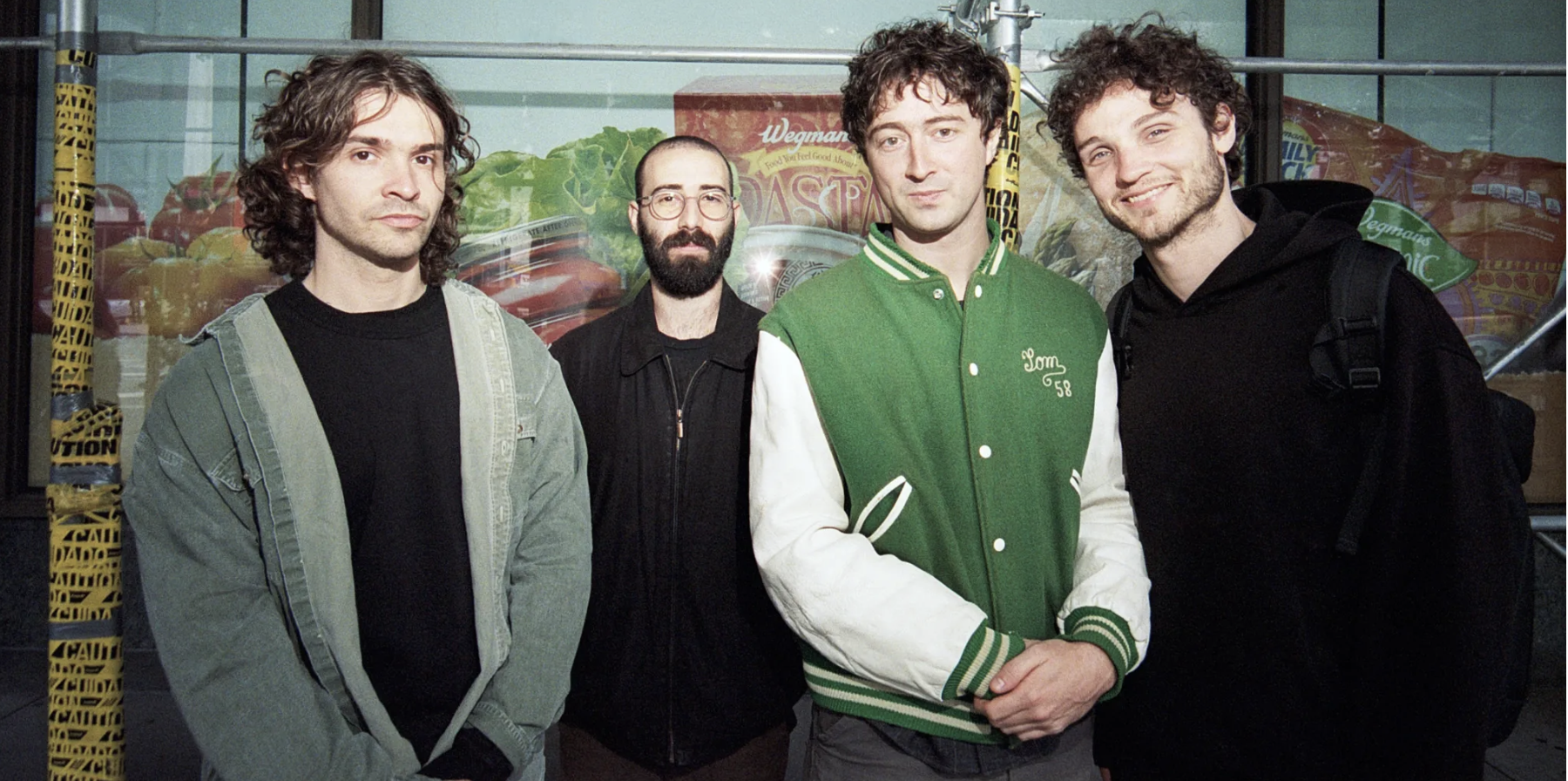
Photo by Eve Alpert
New York City’s YHWH Nailgun have solidified themselves as one of the front-running bands pushing the envelope for rock music as a whole. Few bands have a sound so individual without straying to the point of pure, inaccessible experimentation. Their music is dancey, snappy, and extremely dense with sounds you’ve never heard before. Since their self-titled debut EP in 2022, they have been constantly reinventing themselves, taking on new sounds and styles within the aggressive, rhythmically layered, technical ethos they’ve developed.
Their recent album Magazine is their most considerable statement yet, coming in at only 11 minutes across its ten tracks, with the shortest track “Magazine” being a blistering 35 seconds. Lots of debate online has sparked about a full length project being so short and what it may represent, especially when combined with its ominous sound and poetic themes of religion.
Their live show in Toronto on Sep 18, 2026 was fantastic. The opening act Nudo set the mood with a droney sound collage of Latin influences and surreal singing. The atmosphere they built created a feeling in the room that hypnotized everyone and struck them with a rare beauty. After the intermission, YHWH Nailgun did not want to waste time, opening with immediate fast-paced energy that practically gave everyone whiplash. The stark contrast made the whole show feel expertly crafted, taking the audience on a journey of emotions and sounds they never knew they needed to hear. As Zack (the vocalist) moved around the stage with a dynamic freedom and his neck muscles prominent from the strain of his singing, the audience members crashed into each other like billiard balls, paralleling the refined chaos occurring on stage.
After an impromptu agreement from the band immediately following their show, I was ecstatic. We chatted over the disassembly of their stage setup, with Shayla’s Lonesome Eyebot Magic the Gathering card as a mic holder. In under 20 minutes, we covered the significance of the eleven minute runtime, where the band is headed, Mongolian courtesy, Italian poets, and much more.
The band consists of Zack Borzone (Vocals), Jack Tobias (Synth), Sam Pickard (Drums), and Saguiv Rosenstock (Guitar).
Sascha: You guys had an excellent show. I’ll just start by prefacing that I’m going to dive into some more specific questions about your guys’ sound and how it’s changed over time. With that being said, do you think your sound has significantly changed since 45 Pounds? Is Magazine its own era?
Jack Tobias: In a way, it’s also maybe the final part of this house that we’ve built sonically.
Sascha: This is a certain section of the band, and we’re expecting something brand new, a new chapter?
Zack Borzone: We had slightly different goals, they’ve shifted a little bit. With this one [Magazine] we were trying to do a rock record. Like Jack said, it’s the conclusion of a cycle that started at the beginning of the band and ended with Magazine, and we’ll probably begin a new cycle with the next record.
JT: Maybe a little obvious, but you change [musically] as you change as a person. We’re different people from when the band started.
Sascha: Because you’ve been in this same section in your history as a band, sequencing live shows hasn’t been too much of a challenge—like trying to mix tracks from a couple of years ago with the new tracks?
JT: Well, we play the album as a whole, so it’s not really mixing [songs].
Sascha: I loved the interludes here and there when you’d replay [the title track] “Magazine” just to hit it home again and again.
Sam Pickard: Just to see if you guys are paying attention.
Sascha: Your stage presence is so strong. Zack, you’ve evolved as a performer. I found the oldest live set I could find, one you did at Union Pool four years ago. Back then, you were way more planted with your feet, now you’re much more dynamic on stage. Are you more comfortable now? Is this something that has ironed out over time?
ZB: That’s probably it, you get more comfortable over time. I think when I first started I was trying to channel some kind of nervous energy, channel it into something. Now I’m just comfortable.
SP: There’s also a difference when you’re playing for a crowd where nobody knows who we are. Now we’re playing for crowds that are coming to see us, which is a newer thing for us.
ZB: It changed when we put out 45 Pounds, the way it felt to do shows changed because we had fans. We didn’t really have that before, there was a bit of an antagonism when we first started, kind of like us against the crowd, but when people liked us we had to switch it up. It changes the way you think about it. People are coming in already liking it so it’s a whole different thing. It was actually really weird at first, but then it got normal.
Sascha: Magazine is so short and each song is so strongly defined. I wonder why most songs ended up coming out to that 70 second mark. Why didn’t you guys push it shorter?
ZB: We tried actually, originally [Magazine] was supposed to be like five minutes. We were going to try to do it, and then we realized you can’t really… it just wasn’t working. We wanted to have more.
Saguiv Rosenstock: We wanted it to be five minutes but if the songs don’t work, who cares if it’s five, ten or fifteen minutes. People would get so mad.
ZB: We wanted them to be songs.
SP: Did you say “why not go shorter?” You’re the first person to ask that.
ZB: People usually ask “Why isn’t it longer?”
Sascha: I just wondered—a lot of the songs are so similar in length, 70 seconds seems to be a sweet spot you found for this album.
SP: It was pretty natural. We had an idea going into it. We wanted it to be a short album, but we decided to not micromanage the process as it’s happening. Sometimes you see patterns pop up.
SR: If you look up 45 Pounds, the song lengths are also very similar to each other. You’re in the mode of something like “oh, this kind of works for us right now.”
Sascha: Keeping on the talk of 45 Pounds, I heard that you recorded it on a farm. That’s so interesting to me, what drew you guys to the farm?
JT: The animals.
SR: It is kind of a farm but more than the farm, it’s actually just a really nice studio. [The decision was] more about being away from the city and focusing on the record. They have a few animals but it’s not like a “farm” farm. It’s like an upstate glamping Airbnb for a lot of people. They have ayahuasca retreats there sometimes, and you can just rent out the studio and stay there.
Zack: It’s like a nice little farm cottage.
Sascha: For the recording of Magazine, was there anything unexpected or unorthodox during the recording process?
JT: Oh yeah. The dungeon, there was a head, and a dungeon…
SR: It’s like in a studio, but they have this room that’s insane–not as big as this one [Longboat Hall] and as reverb-y, but think of going into a room like this one and setting up mics.
SP: And we all did semen retention.
Shayla: There was a head…?
JT: There was a head that we recorded into.
SR: Oh yeah. It’s a ridiculous microphone shaped like a head, looks like a guy.
JT: We did it all in 45 minutes.
Sascha: Going back to the animal thing, I noticed, Jack, that you like to sample animal sounds a lot. What draws you to the sounds made by animals in particular?
JT: I just like them… early on it was combining samples from things I liked and wanted to sample, and also royalty free stuff. A lot of that was animal sounds. The way we write, I didn’t have time to go home and add samples so I would just reuse the same samples on a lot of songs.
Sascha: Are there any types of audio or sound bytes you’re interested in exploring in the future?
JT: Yeah!
Sascha: Is it a secret?
JT: Yeah.
ZB: I feel like we were looking for organic sounds initially. Still are.
JT: That’s part of the animal thing, it’s pivoted to people now, even on Magazine.
Shayla: Do you have a favourite person-sound?
JT: We played in Mongolia, and we were watching a video on how they say “Thank you,” and it was a bunch of people all saying it. It’s cool because the way I can use a synth just layers it and layers it.
Sascha: Now Sam, in an interview you expressed that you’re more excited about what’s coming forward with the group than anything you’ve ever done before, so I’m wondering if your presence has become more pronounced, or is there anything you’ve been doing differently?
SR: *joking* He’s not on the next record.
SP: Yeah, I’m excited to stay at home. No, it’s not about my presence, in a lot of ways the drums have been more restrained as time has gone on. And I like that, not to make a rule out of it or anything, but I like having the option to have varying levels of presence in the songs. The songs we’re writing are awesome, that’s all it is. I’m really excited. It’s a whole different thing to be writing knowing that there’s people listening, but also not letting it really inform anything we’re doing. It feels like there’s a reach and more of a gravity once you know people have a connection to it. I think where our heads are at right now is like, we’re writing the best music we’ve ever written, and I think people are going to like it. I think it should always be like that. You always want to be writing the best thing you’ve ever written. I’m just super hyped about it. I haven’t thought that hard about more or less [drums] with the new stuff, it’s more just seeing what happens.
Sascha: Magazine has been compared to gun magazines and print magazines themselves. The speed of ideas you guys have and how everything is so quick and has such a snap to it, it reminds me of the hyperactivity of modern social media. Was that a conscious inspiration for the structure of the album?
ZB: I wouldn’t say inspiration, but it was folded in there. It’s an intuition, definitely, that led to the idea. You make a choice when you’re making art, and later on [upon reflection] you go “oh, that’s why I made that choice,” and it reveals itself to you. I feel like in 2025 it was “ah perfect! we made our most accelerated record,” and it feels like things are picking up speed and getting denser and faster, turning into cycles rather than being a “point A to point B” thing. It’s all kind of wrapped into it more than a direct inspiration.
Sascha: Keeping with the theme of the title of the album, you [Zack] mentioned in a previous interview that the letter “Z” in the title “sounds really good.” That really interested me. When you write lyrics, are you keeping the phonetic sound of the words in mind?
ZB: Absolutely, I think that’s what writing is. It’s sound. If you make a choice based on the musical qualities of language, it’s way deeper. On one hand [Magazine] is a word that just works for the record, and it’s a simple thing, but on the other hand it’s a fractal of meaning and that’s why it works. It’s a double entendre, two images, kind of like a diptych, and you get all the good stuff you can pull out of it. But it’s also just the sound of the word and the letters.
Sascha: Songs get scrapped at every point of the way–are you guys the type to archive your songs and return to them years later or just delete them forever?
SP: I myself am not the type of person to hold on to the songs to look at them later, but we all probably have different degrees of willingness to resurrect old things. I have this weird thing where I never want to do it. If we decided at one point that we didn’t want to do it, I’m like, there’s some meaning to that and we should keep it away. I think that’s all subject to change, I don’t think it’s some perfect rule. I just know my instinct, personally, is always to keep moving.
ZB: The ideas kind of hover over our heads, sometimes they find their place and sometimes they don’t.
SP: Sometimes you write the same song that you scrapped before, later, by accident.
Shayla: I gathered, Zack, that you’re really into poetry. What poets do you like, or what do you like within poetry?
ZB: Image driven, visionary poetry I guess you would call it. I like minimalist stuff. This guy Giuseppe Ungaretti, Italian guy from the 20th century, was definitely in the Magazine universe. I was reading him a lot, he’s really cool. He’s kind of zen, it’s just images and it’s modern. It has this modern, sleek swag to it.
Sascha: Saguiv, you distort guitars in a way like I’ve literally never heard in my life before, it’s so interesting. When you listen to other guitar-centric styles of music, do you feel a disconnect, or is it more of a space to jump off from?
SR: I never thought about being disconnected or connected necessarily. There’s a lineage of weird guitar shit even if it doesn’t sound that weird, even if there’s no pedals, there’s people trying to do new stuff on guitar. I guess in that way there’s a connection. But I’m excited by normal guitars. If it’s good melodies and good playing, it can be just as interesting.
…
After they finished packing up, we cut the microphone and continued to chat about Toronto mosh pits, Saguiv’s pedal setup, and gave each other music recommendations. Jack was especially surprised by my appreciation for 3 Chairs’ self-titled album—an esoteric house album he recommended in a pitchfork interview.
Seeing YHWH Nailgun live was a treat, and being able to talk with them about their music was the icing on the cake. You should all check them out both recorded and live, because they represent a future of unabashed freedom we all need to hear.


Leave a Reply