
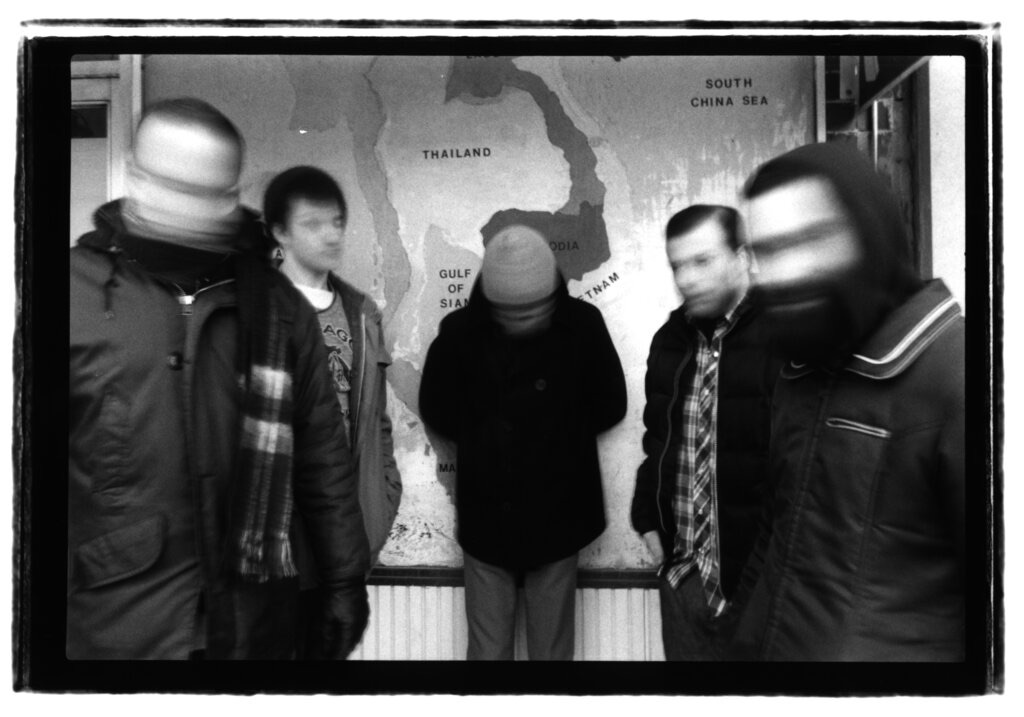
I’m a grown adult. I can buy liquor, cigarettes, and dispensary weed. I can drive, I can sign myself up for the military, and I’ve built up enough of a credit score to sign up for one of the showoff-y metal American Express cards, but the last time Black Eyes played in Toronto I wasn’t even born. Clearly, it’s been a while since they were last in town.
Black Eyes is a Washington DC punk band that was originally active from 2001-2004, releasing two albums on Dischord Records: Black Eyes and Cough. Their reunion in 2022 and subsequent presence as an active band wasn’t something that I, or many others, really expected. It is, of course, welcomed with open arms and massive anticipation. Black Eyes released Hostile Design this past October and have since been hitting a handful of tour spots across the East Coast. The return of Black Eyes in Toronto is a long time coming—23 years to be exact.
The epitome of “cool,” to me, is Dischord Records from Washington DC. Maybe you agree and maybe you don’t, or maybe you don’t know a thing about the record label. Even for those not consciously aware of Dischord, their enormous influence has likely found you in some form. From spawning some of the most influential bands of the 1980s including Minor Threat, Rites Of Spring, and Fugazi, among many others, to the precedent they set in upholding a DIY and all-ages ethos, Dischord is undoubtedly part of the undercurrent that flows through much of alternative music today.
With the return of Black Eyes to my city, I thought long and hard about what I could say about Dischord and their lasting influence on modern DIY scenes. It seemed difficult to put forth one sort of encompassing sentiment on the subject, never mind trying to explain what the label has helped to create in a way that is succinctly packaged. It’s especially true when this proposed quasi-history will be written by someone who hasn’t been alive for even half of the record label’s existence. What the hell do I know?
I figured that what I really wanted was to hear other peoples’ thoughts on the subject rattling around in my mind, and hey, where’s a better place to find those people than at the Black Eyes show? From fans, musicians, and promoters, from teenagers and scene veterans, there’s much more than just my own voice that can express the appreciation there still is for Dischord in Toronto, as well as modern music scenes more broadly. These same fans are also just as jazzed as I am to be able to see the force that is Black Eyes.
The writing below documents my night at the Lithuanian House on March 28th, 2026. Write-ups of the night’s performances by Hysteria, Public Health, and Black Eyes, as well as the interviews that I conducted on-site are presented alongside each other in roughly the order that they occurred. Subheadings can help the reader to more easily navigate to any specific part of the night.
Black Eyes “Letter To Raoul Peck:” “Screaming with one voice we/leave out everything.”
A special thank you to Greg Benedetto, to Public Health, and to Emmett, as their perspectives are what made this piece happen. You’re the best!
Index:
- Interview: Emmett Hartley
- Interlude 1: Waiting Room
- Interview: Public Health
- Set: Hysteria
- Interlude 2: Who Doesn’t Love Dischord?
- Set: Public Health
- Interview: Greg Benedetto
- Set: Black Eyes
- Fin
INTERVIEW: EMMETT HARTLEY
My first conversation of the night was with Emmett, who accompanied me to the show as a fellow fan of Black Eyes. Emmett was an active member of the DC/Baltimore music scene before starting his undergrad at UofT.
…
Shayla Little Maclean: What’s your name and age?
Emmett Hartley: Hi, I’m Emmett Hartley. I’m 18.
SL: How does it feel to be seeing Black Eyes tonight? What are some of your thoughts?
EH: Honestly, it’s incredible. I’ve been looking to see them for genuinely years now. I had a friend back home who saw them, and they constantly keep lording it over me. So here’s to that, Robbie! But Black Eyes is probably one of my favorite bands of all time, ever since I listened to the self-titled. So it’s really kind of a dream to be seeing them in Toronto, of all places.
SL: You were in a band, and they covered Black Eyes a couple of times?
EH: I was. I was in a screamo band back home called Insignia. We have an EP out that you should go listen to. But yeah, we would cover them pretty often. A lot of bands in Baltimore would cover them. They’re pretty influential, especially in the DC/Baltimore hemisphere scene.
SL: Black Eyes is a Dischord band, as you know. Is there anything that you appreciate most from Dischord and what they’ve done, whether it be a certain release or a larger ethos or any movement they’ve inspired?
EH: Well, the ethos is what I find most important about everything they’ve done. And obviously this is kind of rooted in [the work of] Ian Mackaye and a lot of the Fugazi and the Minor Threat stuff, but: all ages shows. All ages shows, and providing opportunity to people of any age to get into music, to get into the scene, to learn the values themselves and experience what it’s like to be a punk, to be striving for change at all times, even if you’re 13, 14, 15, 16 [years old], and, y’know, every other venue will just throw you away with the rest of the trash–I think that’s genuinely the most valuable thing, ethos-wise. And of course, DIY is second to that, I think. But the access and opportunity for everyone, I think, is my favourite thing.
SL: Your attendance in the show tonight is basically a testament to how valuable all ages shows are in the city. Do you have any thoughts on the state of all ages shows in Toronto?
EH: Y’all need to lock in. I have been able to go to maybe three shows this entire year [while at UofT] because all of them are 19+. And honestly, shout out to a lot of smaller organizers and smaller promoters who are committed to doing house shows, all ages shows, and sober spaces—because I think that niche is so important in the music community. But I think it’s a real shame that a lot of the larger venues and a lot of bars and such won’t provide access.
Editor’s note: I would highly recommend checking out Licentia, SHOUT!, and Fuss to those looking for all-ages DIY shows in Toronto.
SL: Do you have a favorite Dischord release?
EH: My favorite of all time is probably Minor Threat, the original [First Two Seven Inches]. Big fan of the song “Straight Edge.” I don’t know if I’m in with straight edge culture, but that release is so good. And then Rites of Spring holds a very dear place in my heart. It’s hard to pick, really.
INTERLUDE 1: WAITING ROOM
This March evening was brisk and cold, and Emmett and I were some of the first people to show up at the Lithuanian House. Anticipation hung in the air amongst the fans standing in the waiting room (I wait, I wait, I wait, I wait…), and anxiety settled in my stomach as I thought about the interviews I needed to conduct. I am a writer and yet I am terrified of talking to people, putting it into writing, and having people read it. What kind of luck is that?
For some people, Doing It Yourself comes easily, but whenever I want something in life it is done while I am so scared my cortisol levels are that of a deer being chased through the woods. Whether or not you’re a massive coward like me, DIY points our energy in the right direction. If you want to see something in your scene, take it into your own hands. Book the bands you want to hear, make the merch you want to wear, build the community you want to be surrounded by, and write the piece you want to read. Various different trains of thought bounced around in my mind while the last of daylight faded away, and soon enough we were ushered into the large and spacious hall of the Lithuanian House.
Tonight’s attendance ranged in age more than any other live act I’ve seen. The Gen Z crowd was rivaled in number by Gen X and elder millennials. A smattering of elementary-aged children imbued with the music tastes of old men tagged along with their parents. A grey-haired man settled into a spot close to the stage and would crack open a paperback novel to read between sets.
INTERVIEW: PUBLIC HEALTH
Before the first set of the night, I caught up with Public Health, a noise-rock quartet hailing from Hamilton, Ontario, who are one of my favourite local bands. Tonight I asked for a few of their thoughts about Dischord and about being a young, up-and-coming band taking on the same stage as Black Eyes. Public Health is composed of Jack Yanover (guitar, vocals), Jake Quinn (guitar), Finley Jones (bass), and Ben Miles (drums).
…
Shayla Little Maclean: You guys will be playing in a couple of hours. How are you feeling about the whole night?
Finley Jones: A wee bit nervous.
Jake Quinn: Little nervous, little excited…
SL: What about it makes you nervous?
FJ: You know, it’s not, like, different than normal pre-show jitters, but it’s… it is a big deal.
SL: High expectations?
FJ: Just like, this band’s a big deal.
Jack Yanover: It’s like, they’re from Washington DC, They’re connected to Dischord. It’s crazy. I love their early records, Black Eyes and Cough, and their new EP is so sick. I’m just really excited.
SL: Absolutely, yeah. That’s what I was gonna kind of go into. Black Eyes is a Dischord band, and I feel like, even nowadays, people still really care about Dischord and still think it’s really cool and interesting. Is there anything you guys kind of appreciate most from like Dischord, whether it be like a certain release, or an ethos, or any sort of movement?
JY: I appreciate just their integrity and how they–especially Ian Mackaye–was just like: “Yes, keep it all ages. Put X’s on the hands,” and he always just kept it as is. Like, even with Fugazi, they never sold merch*. You know, I just really appreciate that. I really appreciate the integrity. And they were able to still sell more CDs and records than most bands, and they did all on their own terms. They released all the records on their own. And Ian Mackaye released plenty of other records through Dischord. I just think that’s super sick, and they really created something super grassroots. And yeah, I’ve always appreciated that. I feel like the modern punk scenes are based upon that, absolutely. Lots to thank from Dischord. It’s really cool that a Dischord band is playing.
*Why not sell any Fugazi merch? Ian Mackaye’s opinion is: “We are a band and we play music… the rest of it is just this carnival surrounding the music business.”
SL: What do you guys think makes Public Health a good opener for Black Eyes?
JY: Honestly, when we got here I was like “we’re not worthy!”
JQ: We were listening to them sound check, and it was a little like, “Whoa.” They’re really next level, yeah. This stage presence and sound they have is crazy. It’s a little freaky. We’re just gonna do our best. We’re here to play some music, I guess.
SL: How did you guys end up on this bill?
JY: We just got asked by Greg [Benedetto of Not Dead Yet]. I was gonna go to the show anyway. I was gonna come down just to see Black Eyes, and then we got asked in late January or something. I literally jumped out of my bed. I was like, “this is crazy.”
SL: Do you guys have favorite Dischord releases?
JY: Probably The Argument, Fugazi. The blue one. Bluegazi. Maybe the Rites of Spring record.
SET: HYSTERIA
The night’s show was introduced with Hysteria—an electronic collaboration between Toronto-based artists Xodkaar and Xicada.
Hysteria’s set built off of constant hi-hats and a dance-y yet sharp and abrasive electronic snare drum. Vocalist Xodkaar would yell with vigor into the microphone, her voice shrouded in reverb and distortion, with considerable angst in her facial expressions. If I heard her correctly, she sang in both English and Arabic. Their sound would progressively build by incorporating synth leads, and creating something relatively industrial and dense, but Hysteria’s set was anchored throughout by their gunshot-sounding snare. The nature of their set was fluid, where bare-bones sounds would gradually develop and then be stripped back again, wavering in and out of different vibes. Emmett likened them to modern industrial artist aya.
Though Hysteria takes on a vastly different genre of music compared to the other bands performing tonight, I quickly understood how Hysteria fit into tonight’s bill—just like Black Eyes, these two are deeply concerned with politics and the increasingly disagreeable state of the world, and their medium to tell you all about it is their music. As per their Instagram, Hysteria “[responds] to a world that insists on violence and dissent between their peoples with their own political and spiritually agent narrative, one born of the kind of rage women embody, ripe with hope and grief.”
In her performance, Xodcaar wielded a serrated knife as she screamed with a fire in her eyes, waving it in front of the crowd. Showgoers stood tall and stagnant, transfixed by Hysteria’s sound. The set was short and sweet clocking in at 15 to 20 minutes, which left Emmett and I wanting more. With tonight’s show being only their second as a performing duo, maybe that was Hysteria’s goal.
INTERLUDE 2: WHO DOESN’T LOVE DISCHORD?
Some might think that asking 20-somethings about their favourite release on a record label primarily active about 40 years ago would be met with extended “hmm”s and “uhh”s, but that wasn’t the case at the Lithuanian House tonight. I had an impromptu conservation with Oliver Clarke, who is from all the way out in Owen Sound, Ontario. He also happens to be the guitarist in another of my favourite bands in the area, Medieval Found Footage.
In his words, “Black Eyes are, like, the coolest band ever, and I was blown away when they were coming back. And now they’re in Toronto, so I came to see one of my favorite bands. It’s gonna be sick.” On his personal favourite Dischord release: “Red Medicine by Fugazi, probably, and then Self Titled by Black Eyes is probably my second. That Q And Not You record* is really good. They’re probably my top three right now, but it changes every week.”
*Editor’s note: I would assume No Kill No Beep Beep is meant here.
SET: PUBLIC HEALTH
Truth be told, the announcement that Public Health would play on the same bill as Black Eyes made March 28th a day I anticipated as much as Christmas. What can I say? There’s not much I enjoy more in life than seeing a great lineup of bands. Public Health was conceived in late 2023, and has been playing shows in cities across southern Ontario for the past two years. They released their debut album, Minamata, this past July, and have since developed a sizable fanbase–including the devoted fan who has repeatedly requested that “Ba & Shu” return to their setlist. Tonight, his wish would come true.
But before “Ba & Shu,” Public Health kicked off the night with “Pod.” “Pod,” alongside other unreleased tracks like “Nervous Country,” give us an idea of what the band is up to when they say their newer material is “more emotional at points” than Minamata. Public Health has a knack for building layers of tension and emotion throughout a song. Their lyrics are often cryptic and fragmented, leaving much for the listener to interpret for themselves and project onto. Vocals on Minamata are purposefully made to sound distant, as if microphones were shouted into from the next room over, and in a live setting, their entire sound translates fantastically. Within what I can hear of their new material, I’m glad to say that Public Health maintains the ability to develop songs in a way that ends in a feeling of crushing emotional catharsis.
Tonight, almost every song felt like the band was challenging the audience. “Landlord’s Son,” a staple in their setlists, starts as an upbeat, noisy, punky tune. Once you become comfortable with what the song presents itself as, “Landlord’s Son” shifts gears entirely and transitions into a minutes-long display of shrieking distortion. Ben Miles steps away from the drumkit entirely as instruments are brought close to amplifiers in order to cause droning and wailing sounds. Frontman Jack Yanover whips his torso up and down in a frenzy and causes painful, screeching feedback to emit from his guitar–I’d see this sort of physical display a handful of times through their set. All the audience can do at this point is stand and watch, which they do attentively. Once they’ve completed their exercise in noise, the band unites again to re-enter a realm we want to identify as music. The song morphs back into something more easily understood. We can nod our heads along to it, maybe while holding a can of the venue’s six dollar Pabst Blue Ribbon. This third and final “act” of the song ends with Yanover relinquishing: “I can’t do it/I cannot.”
This trend of dichotomy could be heard throughout the rest of tonight’s set, all of which are unreleased songs at the moment. “Jargon Lips” and “Live Laugh Love” forcefully swing back and forth between being confrontational and totally groovy, using some delightful clean guitar tones. “Pin Eye (Groupotus)” closed out the night, and its execution had me enjoying how solid this band is. Each member occupies their own corner of the stage, all deeply focused. Together they output a sound that has been tightly honed in on, evidently over the course of many shows and practices.
“Ba & Shu” Guy and I both agreed that “Pork Pint” is the next song that has to make it back onto the setlist. I then made my way towards the soundboard to try to find Greg Benedetto, who promised me an interview after Public Health’s set.
INTERVIEW: GREG BENEDETTO
Greg Benedetto is the leading force behind Not Dead Yet—one of the most prolific concert organizers in Toronto, who are often found hosting some of the best bills you can find in the city. Benedetto has been booking gigs in the Toronto area for the better part of two decades and plays guitar in the iconic Toronto hardcore punk band S.H.I.T. Given his extensive time working within DIY scenes, I had a feeling Greg would have some good insight about the topics at hand. I was right.
…
Shayla Little Maclean: Thank you for talking to me. I think it’s so cool that Black Eyes is playing, and I just wanted to ask a couple of questions. Broadly, has Dischord and what they do inspired any parts of your work, or your philosophy when organizing shows in the local scene?
Greg Benedetto: I mean, yeah, absolutely. Dischord is kind of like the underlying ethos for most DIY music, in North America at the very least. Internationally, probably. But at this point I think that maybe we’re so far away from Dischord’s heyday that people don’t necessarily connect the two things. I think certain actions that centered around DC in the early ‘80s are foundational to any DIY scene following it. It’s kind of like the original version, and everything else is a copy of it, somehow.
SL: Is there in any way one big takeaway you have from how Dischord operated with respect to booking shows and helping to create an active local scene?
GB: I think Dischord is kind of inextricably tied to the very idea of doing it yourself. I think that what that looks like now has changed a lot, but I think that the foundational idea that anyone can book a show, anyone can play in a band, anyone can do any of these things, anyone can put out a record, anyone can book a tour… all of this is is possible, and all of it is done by just fucking normal people. And I think that is, to me, an idea that is foundational to Dischord, or that early ‘80s DC kind of moment. I think especially when Fugazi happened and became much bigger, they just took that to a level beyond what anyone could even fathom. I think a lot of people maybe misinterpret it in a weird way, but I do think that, to your question… that very idea that anyone is capable of anything that they really want to do–and music being a great avenue for it–is a Dischord idea for me.
Greg’s email follow-ups to this question: There was one thing that popped into my head this morning and I honestly can’t remember if it’s a Dischord thing or not–but that that version of DIY enables community. DIY in the Dischord style allows everyone to work together to a common goal which is really the absolute power of it. So while X’s on hands might be a universal symbol from that scene, the true underlying meaning of the action is connection and community building.
At the beginning of the ‘80s (and still to this day), there were movements like what was happening in DC all over the world! Not sure how to contextualize that adequately, but I think when we lionize one person or one scene, it makes things seem less possible. When you realize there are people all over the world doing this kind of stuff, it makes everything else feel a lot more possible!
…
SL: Is this Not Dead Yet’s first time booking a Dischord band? If not, who else have you booked?
GB: Yeah, I want to say the answer to that question is no, but I have to think about it…Oh, well, I booked Messthetics, and that’s two of the four members of Fugazi. And I think their first record, technically, was on Dischord. They’re playing here on May second, again, actually. There’s almost certainly others, but I don’t know off the top of my head.
SL: I’m really appreciative, and I just…I very much enjoy that a young and a local band like Public Health is opening tonight, and just personally, they’re one of my favorites. Did you feel strongly about having them open for Black Eyes?
GB: I mean, I did have that as an opinion, and I kind of pressed Black Eyes on it. I was like, “I think this band should open. I feel like it would be a good fit.” It’s hard sometimes when you’re working with other bands or other artists, sometimes people are just particular about who plays. So, like, as a promoter, I guess sometimes it’s just part of my responsibility to vouch for the things that I think, like… I don’t know if “deserve it” is the right way to say it, but [for] things that are the right fit. 100%, Black Eyes were not familiar with Public Health coming into this, and now they are. And that’s cool, you know. So it’s part of being a promoter that you kind of have to be a connector and have some kind of vision for what the thing is meant to be.
SL: Do you have a favorite Dischord release? I know that’s a big question.
GB: The Faith/Void split is the answer to that question. I’ll go with that as my answer.
SL: Faith or Void? I like Void.
GB: You know what’s funny about that answer? I’m old enough that I see it this way—there was a point in time where, when I was young, it was widely accepted that the Faith side was the better side of that record. And then over time, it became that it’s the Void side. And I mean, I decline to pick a favorite myself. I think both sides are very, very, very, very good.
SET: BLACK EYES
Emmett and I rushed as close as we could to the front of the crowd as we heard the wind up to “Pestilence” from Black Eyes’ newest release, Hostile Design. Tonight’s stage design intrigued the both of us ever since we first walked into the Lithuanian House. Black Eyes is somewhat known for their unorthodox two-drummer lineup, and their unique setup is one of the many things that made this band so interesting to witness live. Two drum kits sit in the centre of the stage, facing each other head-on—one kit a transparent light blue, manned by Mike Kanin, the opposing one a dark, opaque red, manned by Dan Caldas. Singer/guitarists Hugh McElroy and Daniel Martin-McCormick stand at the very right and left of the stage respectively, while bassist and saxophonist Jacob Long is anchored in the middle of the stage behind the two drum kits.
Their stage presence isn’t the only place where contrast is evident through Black Eyes. Vocals within many of the band’s songs are split between Martin-McCormick and McElroy, which injects differing perspectives between the two voices, or simply creates vocals with vastly different energies. In their iconic track “Deformative,” screaming, wailing vocals by Martin-McCormick are layered on top of more grounded shouts from McElroy. It might be the case that McElroy takes a melodic tune while Martin-McCormick might rap, like on “Burn” (To Martin-McCormick’s dismay, Ian Mackaye once likened his delivery to Ad-Rock of the Beastie Boys*). Otherwise, on “Yes, I Confess” and “Speaking In Tongues” McCormick can be heard simply taking on a crazed wail.
*Black Eyes Speaking In Tongues zine
Songs like the aforementioned “Burn” show how Daniel’s vocalizations can often direct the entire feel of a song. The track invites the listener in with an atmospheric yet slightly brooding feel, and McElroy sings soothingly in Greek, translated as: “Rich and poor die in the same way/And go down into the same clay/Rich and poor die just the same/Only memories even remain.” Martin-McCormick interjects abruptly and violently with “Kill your shitty parents, let their blood flow free/Across the hot concrete,” immediately taking the spotlight, and redirecting this song from something that feels subliminal into something immediately confrontational.
I was pleased to see that Black Eyes’ set included songs from each of their three releases, choosing not to forgo any of the crowd-pleasers from their self-titled record. “Fathers And Daughters” from Cough was followed by “Pack Of Wolves,” a song that showcases their ability to invoke intensity and emotion into songs in a way that is almost completely overwhelming. I screamed along to “This fake revolution resolved into pack of wolves,” likely sounding hysterical to people around me.
Black Eyes can feel like witnessing a hundred different personalities within a band of five people. The confrontational and punky “Speaking In Tongues,” has Martin-McCormick bashing on a snare drum and Long manning both the bass guitar and the cowbell. “Under The Waves” followed, now with Long taking on the saxophone and drums. How often do you see a bandmember cycle through four different instruments over two songs–without it feeling gimmicky, at that? To Black Eyes, this type of musicianship comes naturally, and different roles within the band are worn and shed as long as it feels right for them. In “False Positive,” we see drummer Dan Caldas pick up the bass guitar, Martin-McCormick yelps in between manning his own snare drum and playing guitar, all while Long’s saxophone blares throughout. This band is truly unlike anything I’ve ever seen in a live setting.
When I was 16 years old, every listen of “Deformative” destroyed me. At 21, not much has changed, and the track remains one of the most harrowing and devastating songs I’ve ever heard. It leaves little up to imagination in its subject matter of sexual abuse (“You held my wrists/and I’ll never forget that pebble pushing into my knee”), and yet I can’t turn away from it. It’s fascinating to me how even if it isn’t the case that everyone can relate to the content of the song, it still manages to captivate everyone who listens. Black Eyes would be met with pitchforks if “Deformative” wasn’t on the set. The drumming and the layered, contrasting vocal tones and lyrics create something addicting. When both singers unite in announcing “All I feel anymore/And all I can see anymore/I’m 16, driving south from Baltimore/What will I say when I get home?” it always manages to completely break my heart, but myself and just about every other fan in the venue yell the lyrics regardless.
“Deformative” sent off the night at the Lithuanian House. As I started to catch my breath, a woman gave a devastating read of my character. Wanting to get her merchandise signed, she stated I “looked like someone who carried a Sharpie on them,” asking to borrow one. I had two, actually: Do you want black or gold? Meanwhile, the members of Black Eyes were kind enough to sign my copy of Speaking In Tongues and accept the copy of Demo’s newest issue that I offered them. No, I never stop shilling the magazine.
FIN
I said my goodbyes to the people kind enough to talk to me tonight, then indulged in my post-show ritual of seeking out a slurpee at the nearest 7-11. Emmett and I’s bodies felt broken but our spirits were high. On the eastbound train home we talked about how we want to book more of our own shows through Demo, and how we want to do so very badly. They’ll be cheap, they’ll be all-ages, and they’ll likely be hosted in rooms at UofT campus that are unsuited to being venues. The DIY disease is contagious and real, and thanks to all this talk about Dischord, we’ve caught it bad.
“The foundational idea that anyone can book a show, anyone can play in a band, anyone can do any of these things, anyone can put out a record, anyone can book a tour… all of this is is possible, and all of it is done by just fucking normal people.”
We’re just normal people who can take things into our own hands. I’m very hopeful for the future.


Leave a Reply