
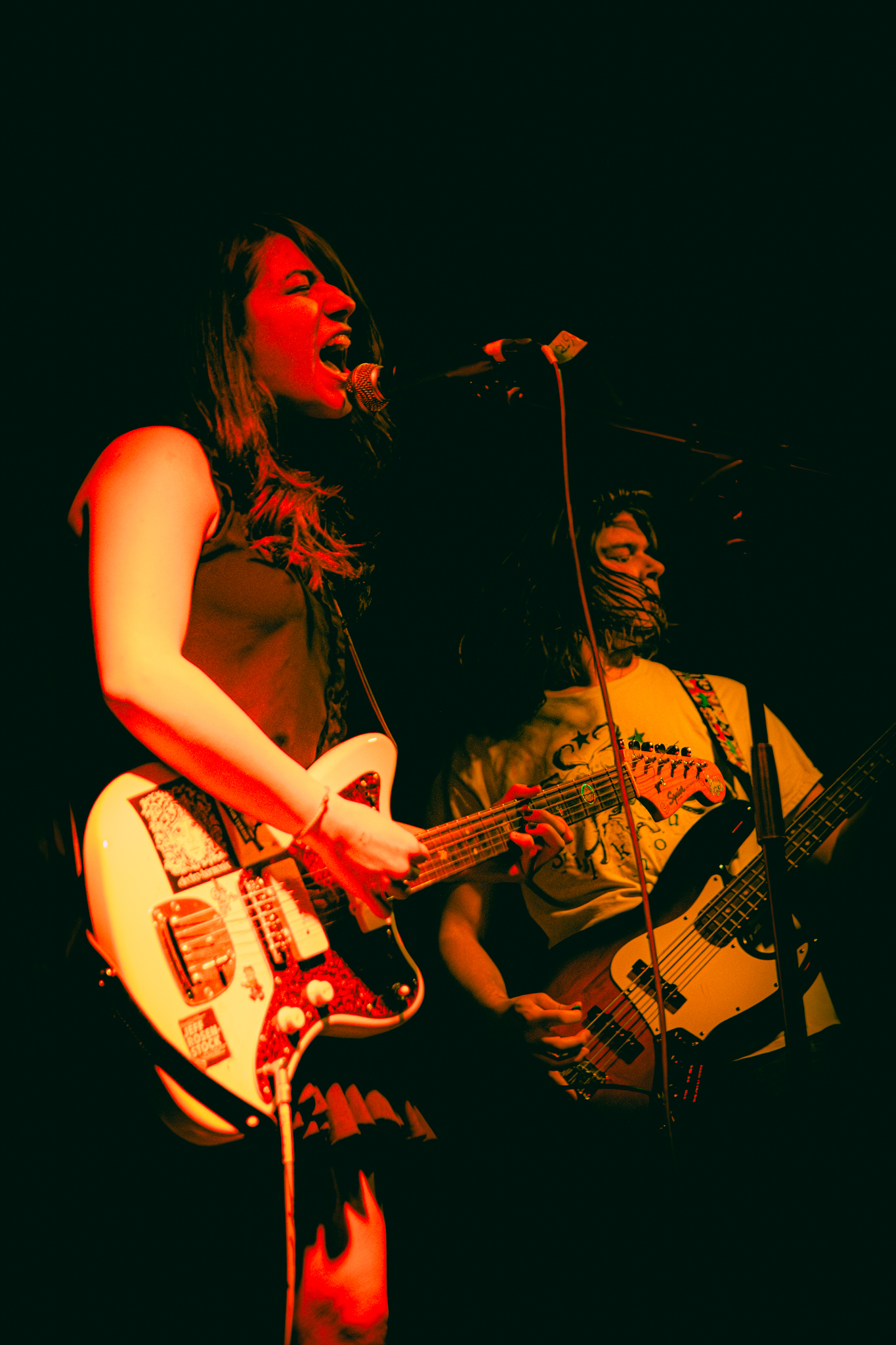
The best part about shoegaze for a passive fan like me is that I have no fucking clue what the word itself defines musically. What started out as a belittling term for those who lovingly stared into the deep souls (soles) of their guitar pedals during shows became synonymous with music in the ‘90s that harboured a crushing wall of sound, and then expanded tenfold to mean pretty much anything with a “Fuzzy Guitar Vibe.”
I have, mostly, no problem with this genre being very open-endedly-defined. People keep telling me about the internet’s “shoegaze revival.” This revival is perhaps largely due to the genre’s continually-expanding definition, as well as its ability to be aestheticized on shortform video platforms that center on quick visual impressions. The hashtag for the band Duster—a band that Mark Richardson from The Ringer described in 2019 as those who “are not, were not, and never will be, a ‘big band’”—now has over 1.5 billion views on TikTok. That is a jump that seemed incredibly impossible pre-pandemic, but once Gen Z listeners got involved, things changed. Zoomers currently outrank all other age groups combined on every major streaming platform in the consumption of shoegaze music.
My only qualm with the aforementioned internet-based revival is a skepticism of it resulting in a genuine, exciting new shoegaze scene out in the real world. However, lineups such as those presented at Loveless Festival largely prove my worries to be wrong. Loveless Collective’s goal to curate a thoughtful space that reflects the Gen Z listenership is an admirable and intriguing one.

There’s that famous saying that goes “Everyone who listened to the Velvet Underground started a band.” The Velvet Underground’s experimentation with feedback and warping of electric sounds influenced the sonic boundary-pushing by ‘80s and ‘90s shoegaze bands. The subsequent resurgence of these classic groups has led to a fresh spin on shoegaze by Gen Z bands who take on a looser, more atmospheric sound. For our purposes, the saying could just as easily go: “Everyone who got excited by My Bloody Valentine, Slowdive, and Ride during the pandemic has now started a shoegaze band.” Since “shoegaze” as a term can now refer to such a wide variety of subgenres, starting a shoegaze band is particularly exciting. The genre encapsulates something new, and pushes young people and artists to find a sound that reflects our unique position in this world.
Young people are, in every discipline, being told to take the most marketable, and thus often least original route. In music, we see the reward of sticking to this script through big labels taking on AI artists, and general signing protocol shifting to emphasize online engagement rather than musicianship itself. Therefore, it makes sense that bands would stick to a boxed-in sound that they know sells on the internet. Shoegaze, however, exists as a somewhat-safe yet still musically-compelling alternative to this creatively depressing approach to music. With its ever-evolving qualities, never stuck to a very tight list of musical requirements, the genre acts as an “out” for young artists who want to make original and challenging music that still has fan appeal to it.
Loveless Collective’s shoegaze lineup, fronted entirely by young artists on May 10th at the Supermarket in Toronto’s Kensington Market, was something exciting. Closeout, White Rabbit, and Cherry Pick all brought different soundscapes to the show while simultaneously blending as a lineup due to the thoughtful curation of the Loveless team. The acts had some overlapping influences, citing modern shoegaze bands julie and Wednesday as inspirations.

Closeout was the first band to play, ironically enough, starting off with the aptly-titled “Soothe.” Lead singer Daryan Dunn has an emphatically sweet voice, which was not what I expected considering the immediate heaviness I heard from the powered instrumentation by bassist Beck Jessop and guitarist Andrew Dailey. The contrast between Dunn’s voice and the musicians’ even, propulsive playing made Closeout’s music immediately intriguing to me. Dunn displayed such ease with every high note, and at the most comfortable moments of their set she maintained a playful and robust command of the dynamics of her voice—jarring sounds, despairing screams, an ugliness of the voice—all of which created variation from her sweet soprano. I would have liked to see her explore more of these deeper moments of her voice. There was a rawness when she would switch up the tone of her voice that I enjoyed, such as on their fifth song, “Mercy,” where Dunn’s vocals had a wailing quality that was dissonant in a way that was somehow still pleasant. Jessop and Dailey had a great internal rhythm that shifted and switched up in interesting patterns, particularly on their more intense songs like “Mercy,” “Unravel,” and their last song, “Brittle.” On “Brittle,” which I thought to be the strongest of the set, Dunn built up the strength and volume of her vocals throughout the track–sometimes at the same time as guitar and drums and sometimes contrastingly. The interactions between all the elements of the song came together fervently, with some unpredictable guitar and bass lines that bordered on percussive. The band mostly played off of each other, with the occasional moment where they seemed to lose sense of the band as a whole, due to some equipment and technical challenges. However, they always recovered easily and it was evident that they played together as a musical team. When I asked them how they would describe themselves as a group, they stated that they “try to keep everything very intentional, emotional, and as exciting as possible,” which makes sense, as Closeout is at their strongest when they find comfort in playing with the emotional and musical dynamics of their songs.

Toronto-based four-piece White Rabbit was up second. They opened their set with a slow and semi-isolated drumbeat that gradually got faster until lead singer Sabrina Perez’s voice broke the wall of sound and truly kicked off the set. Their sound combined classic shoegaze with indie rock, and the band later told me an influence of theirs is Alex G, alongside more shoegaze-y bands like TAGALOG and Ovlov. These inspirations quickly become evident in their chord progressions and strumming patterns. On their second track, entitled “Play Fair,” drummer Ben Miles harmonized with Perez. The two would continue to do this at various moments throughout their set, and their voices sounded out of sync in a very charming Belle and Sebastian kind of way. This dynamic made for what I thought to be the best and most musically whole moments of their set. Occasionally they would sing the same line but an octave apart, which also emphasized this slightly offkilter but balanced vocal duo. Perez’s voice worked really well when her vocals were brought into the universe of the instrumentals through Miles’ vocals and repeating motifs, but at points it became slightly overpowering on its own. Perez’s vocals occasionally lost a seamless connection with the rest of the band due to its strength, which both worked well for some moments and took away from others. Perez is also a lovely guitarist, and had a great solo on their second last song “Trick.” Justin Gebel, the bassist, was a solid anchor that drove the rhythm and had some great melodic lines throughout the set. The band described their sound to me as “melody forward indie rock with a shoegaze atmosphere,” and this vision is evident in their live performances, which resulted in a confidence that made it clear they knew how to play to a crowd.

The final band of the night was Cherry Pick, a Vancouver-based shoegaze group. Their strongest attribute was their control of noise. Lead singer Cherry’s voice contrasted pleasantly with the harsh guitar lines, and their music seemed to continually change its mind about where it was going, which kept a first-time listener like myself captivated. They were no-nonsense, and had seamless musical transitions between songs, which meant that you were never sure when one track ended and another began. When asked, they described their vibe to me as “loud-quiet-loud,” which I thought was interesting and recalls some music history. Loud-quiet-loud was the sound formula that defined noise rock and grunge, and is less associated with a shoegaze sound. However, you could see the statement’s connection to the building-and-releasing of musical tension throughout their set, with Cherry Pick toying with rhythm and dynamic shifts endlessly. They let their guitars make feedback that was so torrentially loud it physically hurt, and then used the same feedback to start the next song, building on rhythm and atmosphere-setting until they had completely changed tracks. I thought it was a smart technique to immerse us from start to end, showcasing that wall of sound that is so central to shoegaze. Bassist Tao Dasilva took over vocals on their last track, which didn’t necessarily provide as much contrast as Cherry’s higher-pitched vocals and wouldn’t have worked for the whole set. However, this swap worked to blend each element of the band together through its lack of obtrusiveness and mellow quality. Each choice the band made felt intentional: they made the audience stand quietly and uncomfortably due to the jarring nature of their sound, and then dance a second later (shout out to the single mosher in the crowd). Overall, Cherry Pick played a musically expansive and versatile set.
If you noticed that I didn’t comment on any of the band’s lyrics, it’s because I honestly could not understand what anyone was saying for most of the night. This is characteristic of the shoegaze sound, both now and in its initial heyday. Sometimes lyrics are incredibly important, but sometimes you have no idea what is being verbally expressed and yet you still feel the music within you. In shoegaze, it doesn’t always matter what the words are.

I learned a bit more about Loveless Collective themselves after the show: They started out with small house shows and gradually built up a DIY following. They can now bring in bands from around the globe, for what they stated is Toronto’s only shoegaze-focused music festival. Not to dwell on the fact that all three bands at the Supermarket were female-fronted, but that is not a small feat in the perpetually male-dominated DIY music scene. Loveless is really creating something new where great artists can show their art and what they care about without having to think about the sleek bullshit that begets more commercial routes.
Shoegaze is traditionally a genre filled both with dreams and escape routes, as well as introspection. The new shoegaze encapsulates the same feelings but doesn’t forget to bring in the interconnection of genres that caters to the tastes of youth that are used to having endless access to music. This genre synthesis permeated the Supermarket show, with most of the crowd, as well as the bands themselves being made up of students. In a time where youth are lonelier than ever, it’s important to have music by and for young people to maintain a sense of connection and shared excitement towards something real and tangible. Go see one of the rest of Loveless Collective’s shows, and check it all out for yourself!


Leave a Reply