
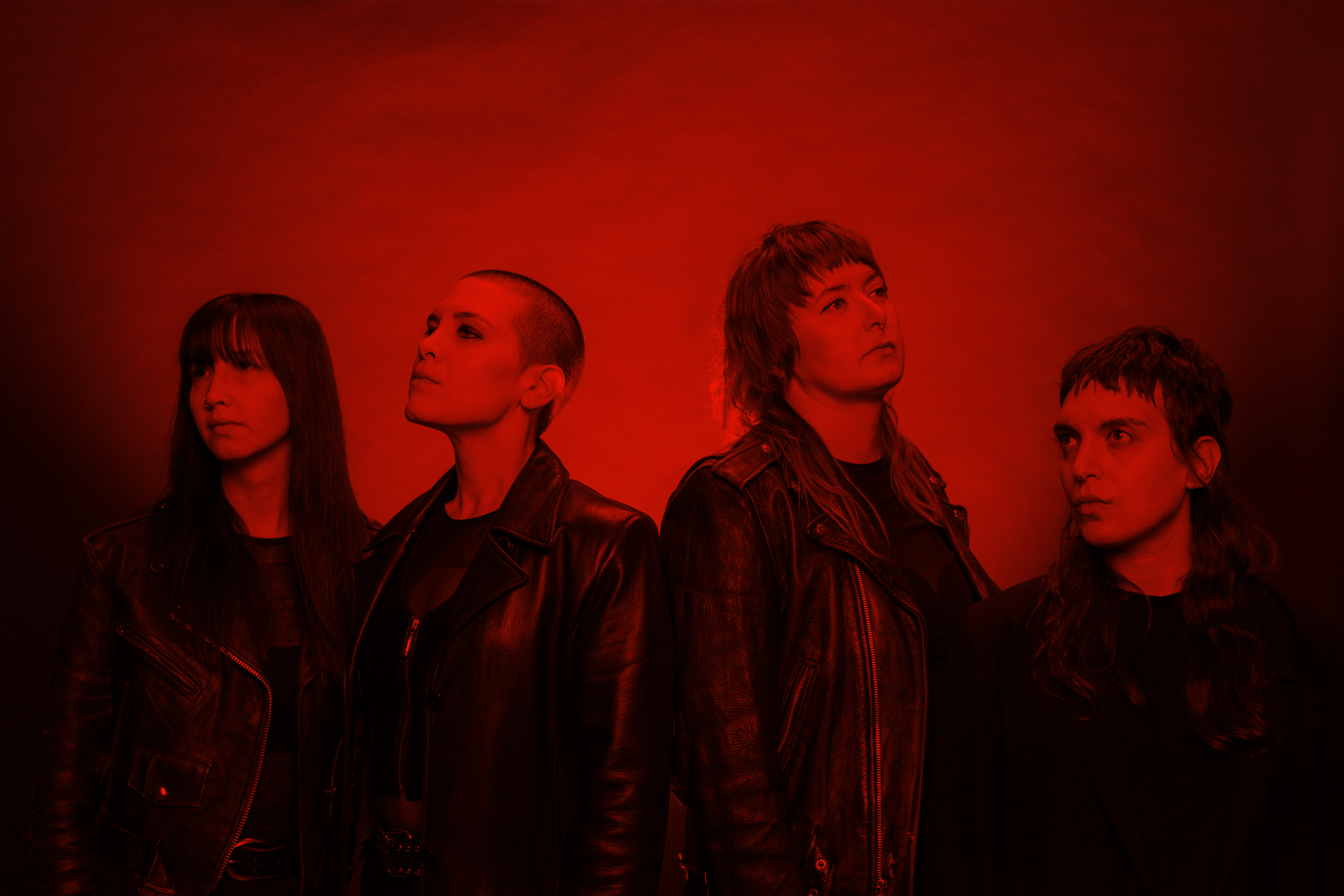
Photo: Dana Bellamy
Music and writing have long served as vessels for processing complex emotions such as grief and death. Heavy genres like metal and goth have always had an association with the macabre, most notably motivating the satanic panic of the 1980s. Yet past its frightening exterior lies an understanding of death as a natural stage of life, which becomes especially meaningful when confronting something as uncertain and difficult to articulate as grief. Through music, words, stories, and history, these emotions are preserved and made immortal against the ravages of time.
The founding twins of Guelph, Ontario-based quartet Bonnie Trash build on this tradition of expression by using heavy music as a tribute to their grandmother, Nonna Maria. Her stories and words form the basis of the themes in their earlier music, through ghost stories and Italian folktales passed down across generations. In the wake of her death, the band processes their grief through their latest album, Mourning You. Within this relationship with their grandmother, a moving story of love, loss, and acceptance emerges.
I spoke to Bonnie Trash ahead of their upcoming performance at Loveless Festival, which takes place in Toronto on July 25th and 26th. The following conversation has been edited for comprehension and clarity.
Julianna Pijar: Beyond being twins, how did you form as a group and know that you wanted to become a band?
Emmalia Bortolon-Vettor: Sara and I started Bonnie Trash as a duo, initially forming in 2013. It was birthed out of us wanting to get back to our heavier roots and wanting to play some heavier music, because that really fed our souls. But I think what really solidified us as wanting to be and perform as a full band was when we finished Malocchio.
Sarafina Bortolon-Vettor: We took many years to develop who we are and to carve the sound that we wanted. Our first EP, Ezzelini’s Dead, was a DIY recording in 2017. That kickstarted our intrigue. But I’ve always wanted to be in a band since I was a preteen, and it all began when my sister started playing guitar. We formed the band that you see now with our friends Dana Bellamy (bass) and Emma Howarth-Withers (drums), who have been with us since 2021. Emma and I recorded Malocchio with just us on that recording–Emma played guitar and bass while I did the drum parts and the singing.
JP: Who are some of your musical influences? What was it that got you into metal and heavy music in particular?
SBV: The first record I ever remember spinning on vinyl was Black Sabbath by Black Sabbath. That album was the pivotal record that got me interested in heavier music. Some of my favorite bands of all time are The Sisters of Mercy, The Jesus and Mary Chain, Siouxsie and the Banshees, The Cure, and The Damned. For grunge, Nirvana’s Bleach is one of my favorite records. I love Hole and Garbage, and Annie Lennox too. In newer bands: Regana, a fantastic two piece from the states, and Witch Club Satan. They combine witchcraft and feminism and black metal. And of course Amyl and the Sniffers, who we’re seeing next week. [Amy Taylor’s] presence as a frontwoman is powerful. So as a frontperson, I’m really looking forward to seeing that live performance. One last band is Refused. The Shape of Punk to Come is a brilliant record and I was very lucky to have seen their last show in Canada at History. It was amazing.
EBV: By default, it’s going to also have to be Black Sabbath by Black Sabbath, because we would have listened to that album at the same time together. British Steel by Judas Priest is always a classic. What brought me back to metal in my twenties was Godspeed You! Black Emperor and early BIG | BRAVE. It was a sonic revelation for me when I realized I don’t need to shred to be heavy. That was a really big gamechanger for how I wanted to approach playing guitar, by being able to hear that sonic element of moving away from this type of precision and create something much heavier for my tastes. It was really influential.
JP: I agree, because in doom, with bands like Black Sabbath, Sleep, and Electric Wizard, they are heavy, while also being so slow moving and so ominous, and it’s without shredding. Horror is a large influence in your music, seen through your music videos and especially in the opening track of Mourning You. How do horror movies play a role in your music? Who are your favorite directors and what are some of your favorite movies?
EBV: I really appreciate how John Carpenter’s soundtracks use minimalist layering to paint context. His pieces are really great and are also really inspiring. Especially if you think of the story of making Halloween with no budget. I love being able to create intro and outro tracks that bring the listener into our albums and into the spirit of what it is.
SBV: Emma and I were really lucky that our first person to show us scary movies was our dad. Watching all the classics like The Exorcist, and Evil Dead. [Horror’s influence] also stems from our Italian background. Our Nonna Maria regaled us with real life supernatural horror stories, real ghost stories, and stories of exorcisms. But there was a truth behind those stories, in terms of [Nonna Maria] feeling a presence in her home, with her having to deal with the malocchio, which is the evil eye in Italian. With our music, Malocchio was about archiving her stories and ensuring that those stories were told, especially in her dying [Trevisàn] dialect. It was a means to preserve and archive her language and stories or else they would be lost. With Mourning You, it’s about the grief that comes from loss, as we lost her after Malocchio. We used the horror genre to move through grief and confront it head on. Some of my most influential directors are Dario Argento and Alfred Hitchcock. John Carpenter is a massive influence. The Thing is one of my all time favorite movies and soundtracks, too.
JP: I wanted to discuss your grandmother’s influence in your music. Malocchio and Ezzelini’s Dead are based in Italian folklore, with her voice also being on the releases. In Mourning You, it shifts to your grief of losing her. Could you talk about that thematic transition more, and if there’s anything you learned from the first album that you carried onto the second?
EBV: Sara had mentioned how Malocchio was a desire to preserve both dialect and stories from the north. They’re very different in how they approach the malocchio than you would find in other regions, especially the south. There was a desire to create a collaboration with our Nonna. She was really interested in wanting to tell these stories and would definitely ham it up a little bit and wanted to be a part of it. We were not only archiving it but we were placing ourselves as the grandchildren within that archive. That was the creative spark with Bonnie Trash—that was us starting to reconnect with our Nonna and work on this history about the tyrant that was in their hometown. We were able to blend conversations we had with her and also with her brother, who was in San Zenone degli Ezzelini (northern Italy). There’s something so special that we were able to place them together in conversation, even though they were many hundreds of kilometres apart. In Mourning You, there was the loss in realizing we’ve lost our collaborator, too. Those intros and outros have changed because she’s not there to tell the story anymore. So rather than us building up story and context, it was collections of sonic ruminations in processing that loss. Instead of being bookended with stories in order to scare, the album was bookended with sounds of despair. That’s the difference between those two.
JP: Speaking of the latest record, Mourning You, beyond this feeling of grief and death as an overall presence, are there any other major themes you’re trying to express?
SBV: From my songwriting perspective, Mourning You is about moving through grief and tackling it. Using the horror genre visually through music videos and dialogue is a way to recognize and embrace grief as a way of remembering somebody. That record, just in the title, speaks volumes in terms of the themes. Songs like “Hellmouth” are all about grappling with grief head on. “Your Love is my Revenge” deals with the guilt you feel when you wish you could have done something, or you wish you could have spent more time with someone. “Veil of Greed” is very much a horror-based track, where the chorus is all about feeding and consumption, and how grief can consume every part of your body. I miss my Nonna every day. It’s not easy. It’s not easy for anyone to lose somebody they love, and it was an honour and privilege to have collaborated with her on Malocchio.
JP: Even though you’ve lost her, her culture and stories live on and are preserved in your music. I feel that metal has always broached tough topics and is a really good way for people to process their grief.
EBV: Absolutely. It’s fascinating and empowering to know that part of what allows us to grow as humans is the embracing of darkness and finding ourselves in these spaces of darkness. It’s really important to have so many different voices speak about how they see themselves, especially of existence in happiness, rather than in continuous spaces of being destroyed.
JP: Regarding the record Mourning You, which were your favorite songs to record and to play live?
EBV: I liked recording “Haunt Me.” I think we had a great understanding of how we wanted to approach it, and we left a little bit of extra time for mystery and textures to come through.
SBV: They were all my favorite to record! But one song that was a real challenge, and it’s my favorite from the record, is “Your Love is my Revenge.” Josh Korody, [who we worked with on recording this album] scrapped it at first and said we had to go back and redo it. We went back in and rerecorded it and I’m just glad he pushed in that regard. In terms of playing the songs live, I love playing “Haunt Me.” That’s a really fun song to play, it’s a fun heavy doom-y track. It’s a joy to play all of them live, though.
JP: Let’s say there’s someone who is not familiar with metal or goth: how would you describe your music and sound to them?
SBV: It’s a question we get asked all the time and it’s really hard to pinpoint a specific genre. At the end of the day, we’re a gothic rock band that has influences in doom and shoegaze and post punk. In the past couple weeks, we’ve been thinking it’s more gothic rock.
EBV: I like saying post-apocalyptic goth.
SBV: Josh said it one time: post-apocalyptic doom.
JP: You’re in Guelph now, but were based in Toronto for some time. How does being in this part of the world shape your music?
EBV: I think the benefit of living in Guelph, while being on a label and being easily able to perform in Toronto, is that you get to experience the influences in Toronto. Toronto has a great variety of heavy, no wave, and goth artists. But we made the decision a while ago to move back to Guelph to be closer to our grandparents. We wanted to really live and have more stories with them, because there was a regret that we were not spending as much time as we would have liked to spend with them.
SBV: Toronto’s the best, but I really do enjoy living in Guelph. There’s a certain quietness, slower pace, and peacefulness here. As Emma said, it was a no brainer to move back closer to our Nonnas. So it’s really nice to be around them, and it’s wonderful to be close to Toronto too. But Toronto has such an incredible music scene. Living there in my early twenties had a profound influence on me in the kinds of music we compose and who we wanted to work with. When we were writing Malocchio, we reached out to Josh Korody and started working together. We loved his projects. He worked with [Toronto rock band] Dilly Dally too. Outside of heavy music, I think that all genres within Toronto are bustling right now. I love Chinese Medicine, Shiv and the Carvers, and other heavier groups that way.
JP: Yes, there’s so many great bands in Toronto. Alvvays is one of my favorites. I also really like Wine Lips, the OBGMs, there’s also a lot of shoegaze. You mentioned local Toronto bands, are there any other contemporaries you like?
EBV: I think to keep it very Toronto: Big Pit, Burner, and Bad Waitress. You’ve mentioned OBGMs, I love them too. And I’m thinking of bands that are playing the Loveless Festival too—Sunsetter, Basement Revolver, and The Neverminds.
SBV: I can’t wait to see The Neverminds. I’m so stoked! Oh, and you forgot Slash Need.
JP: What made you want to be a part of the Loveless Festival?
SBV: Their collective and curation of shows is so carefully [put together]. Ginny, one of the organizers, has been so lovely and we’re honored to have been asked to play the festival. It’s really fantastic to see the newer collective bringing more shoegaze to Toronto, and building a primarily shoegaze festival. We’re big shoegaze fans. I love the classics, like my bloody valentine and Slowdive.
JP: Lastly, how did Bonnie Trash become the name of the band?
SBV: There’s some dualities to it. Back in 2013, I was listening to a lot of Johnny Cash and I thought Johnny Cash and Bonnie Trash go together. But there’s more to it. I think Bonnie Trash is more so a reclamation, like “good” trash. Like how women and non-cis males have been called trash, garbage. It’s bringing that ownership back into it. That’s kind of how I see Bonnie Trash, it’s good trash.
EBV: And it rhymes with Johnny Cash.
SBV: It’s so silly. It’s kind of like Garbage, what a great name, and our friends at Hot Garbage. What a great bill would that be? Garbage, Hot Garbage, Bonnie Trash.
Bonnie Trash’s music demonstrates how music can be applied as a means for memory and preservation, encapsulating a specific feeling in time. Rather than fearing darkness and the unknown, their songs embrace death as another way to understand love and loss. In doing so, Bonnie Trash continue a long tradition within metal and goth, using the macabre not for shock, but to give voice to the emotions that are often the hardest to express. Be sure to catch this local band playing in their favorite city at Loveless Festival on July 26th.


Leave a Reply