
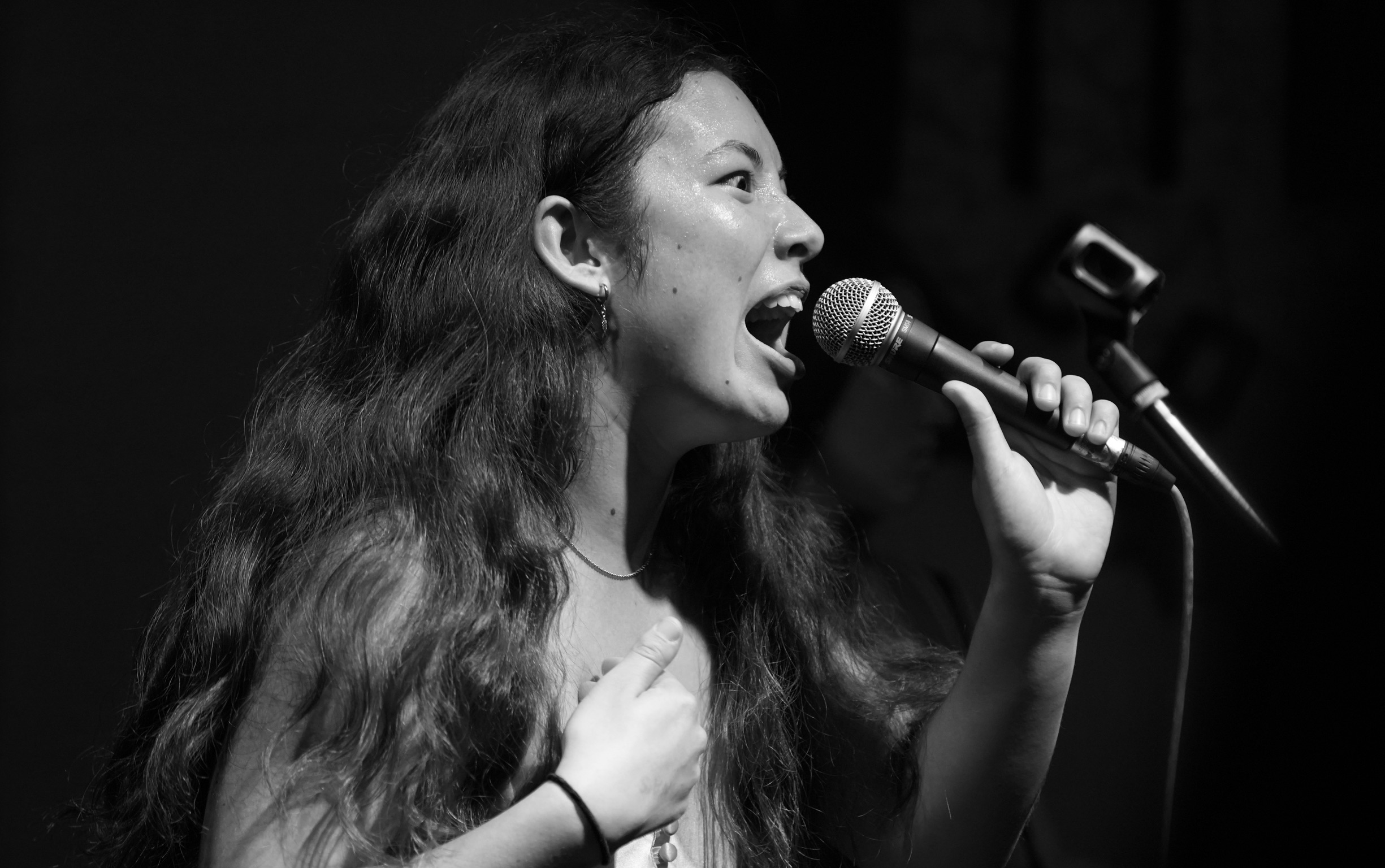
You will never see two brighter, kinder, more-laughter-filled faces in the Toronto punk scene than those of bandleaders and twin sisters Bebe and Oona Sun Cutter. They’ve been performing together practically since they were born, but have been playing shows as a band for four years after starting as high school students. The whole band is a friendship and love affair: Bebe and Oona’s drummer, Rylan Foley, has been in a relationship with Bebe since the formation of the band, and their fourth rotating member is always a friend of the band. “We love to play with our friends! It makes creating together more fun, and we think it shows to the audience and makes them have more fun, too,” remarked Bebe to me in an informal interview with the band.
In full journalistic disclosure, Bebe and Oona are two of my closest friends. I will admit my bias upfront while also stating that this closeness has contributed to my understanding of their band and its growth from when they first started to play shows in high school until now.
Bebe and Oona describe their music as a mix influenced by post-punk and indie rock, but it would be not entirely correct to describe them as so without mentioning the overarching and larger-than-life performability and playfulness of their music. They are not a band that records and then plays live with what they’ve recorded; everything they create starts with imagining what it will sound like to an audience and goes through rounds of tweaks and adjustments as they see how people react to what they play. Oona stated, “We originally focused on tight harmonies and intricate vocal arrangements. Playing a lot of all-ages, heavier shows helped us be louder and more energetic. We learned that the audience and the live energy matter as much as the song itself. We realized the best approach is to play the songs we want to play and let the energy guide performance, rather than confining ourselves to a predetermined vibe.”
A few Fridays ago, I watched Bebe and Oona (the band) perform at Trinity Common as part of the 2026 NXNE Music Festival. I arrived a few minutes into their set, and the crowd was already bustling. As I scanned said crowd, I noticed many people who came to the show not knowing Bebe and Oona appearing visibly shocked by their semi-hardcore sound, which appeared in deep contrast to their bubbly demeanours. Their sets are coordinated in a way that flows almost like a play. They make great use of swells in louder, harsher songs as well as quiet moments in more mellow songs, and always end on a crowdpleaser that gets the whole audience dancing and smiling, often their first released single, “Nosebleed.” Ending with that very track at NXNE, even in this unfamiliar environment, they had a large group singing the chorus with them.

Bebe and Oona the Band performing at Trinity Common, all photos shot by Sophie Montpellier.
Bebe described their writing style to me as “coming from us wanting people to dance along.” She says that, “We started off very much just playing to friends… we are so close to the audience, we end up literally facing each other.
It’s almost like a conversation.” And the audience didn’t fail to hold up their end of this conversation at NXNE—at a Bebe and Oona show, everyone is dancing because everyone feels safe, and everyone feels like the music was made for that very moment.
Many of their loyal followers are women, and having that audience in the Toronto hardcore scene has not been something they take for granted. Oona acknowledged that their sound doesn’t exist in a bubble: “It’s a balance of staying true to our sound while recognizing the broader social dynamics. We want to foster a scene where femmes are visible and supported, not sidelined.” While their shows are always an epicentre for positive energies, the work they have to do to create these comfortable spaces is often more than what their male peers have to do when getting ready for a DIY show. With years of experience both playing in the Toronto all-ages scene and going to friends’ shows, Bebe and Oona know that being the only girl in the mosh pit is not the most inviting feeling. In response to this, Bebe thinks that “a really great way to address [the disparity] is to have more female bands, because that brings a different kind of presence and awareness in the crowd… It can be frustrating, however, that we often have to think about things that I wonder if a male band would ever have to think about. We’ll ask certain bands to play a show, and they’ll tell us, ‘Oh wait, that other band you’re playing with has someone in it who’s a sexual assaulter,’ or, ‘That venue you’re playing at— the bouncer there assaulted me.’ Then it becomes, ‘Okay, is it going to be safe for our friends? Is it going to be safe for us and the other bands we play with?’”

“It feels as though at the end of the day there are only like five venues left that we can play because people have had bad experiences at [all of the others], and we want to keep our female fans safe. Meanwhile, all these male bands can still play those same venues, because… it doesn’t affect them in the same way. It almost feels like we’re excluding each other from being able to play because we have limited options. And I feel like men [will often] just be like, ‘Oh, you won’t play there? That’s too bad. Okay, we’ll find someone else.’”
Many of their songs address what it means to be a woman making music outside of what is expected of you, such as one of my personal favourites, “Alethea.” This track was also the second song they played at NXNE. With lyrics about wanting to be like an older female role model who herself does not confine to what is expected of her, the song brings out high energy from Bebe (lead vocals) who has what looks to be the best time belting the chorus exuberantly, “Take me chasing/Take me chasing bad news.” Bebe sings this chorus like her life depends on it. You can feel the pure force coming from it as the audience dances along. Bebe said to me that “Alethea” was her favourite song to perform, because “it is so much fun to sing, and summarizes my experiences being a young girl with everyone putting expectations on you to follow rules in some way, which is frustrating because I always do try to follow the rules, but I feel like ‘Alethea’ is everything that I want myself to be… When I’m singing the song and it’s to my friends, I love when they sing the lyrics back at me. I feel like we are being crazy together through the song, and it’s almost like an outlet for me.”
In the song, Bebe sings one line repeatedly: “Off track/Off track,” without guitar, so that she can really play with her theatrics. She runs around the stage, comes into the audience to sing with her friends, and interacts with the rest of the band members.

Another of their favourite songs to perform is “Heartbeats,” a pseudo-love song written by Bebe, which at NXNE was performed with both male and female vocals. Oona’s voice was complemented by stand-in guitarist and friend of the band Andrei Ghita’s vocals. “Heartbeats” is one of their softer tracks, with a crescendoing buildup that relies on Oona’s steady bass throughout the song. With repeated vocals that layer on top of each other, they create an environment of people somewhat in a trance—exhausted from so much dancing and ready to sway along for a beat, before another, more high-energy song comes in after.
Now that Bebe and Oona go to university in Montreal, they know a thing or two about what it takes to keep a scene alive, as well as all the differences between the two DIY scenes of Montreal and Toronto. When asked to compare the two scenes, they said that “There are a lot of differences. One of the most obvious things is that when we played in Toronto, we could only really do all-ages shows, as we weren’t yet 19. And in Toronto, you often have to pay to play—sometimes up to $1,000 per show. We’d basically recycle the money: whatever we made from ticket sales would go straight into funding the next show. We do a lot of fundraising shows [in Montreal], so that’s a bit different. McGill, for example, has Jam for Justice, which puts on tons of fundraising events. Those shows are really great to play because the community is so strong and supportive. A lot of our audience in Montreal so far has been connected to McGill or university circles—so mostly students. We’ve played a lot within that scene, but we definitely want to branch out more… [and play with] more Francophone bands. Most of the music we encounter is in English, and most people we talk to at shows speak English. But we’re interested in expanding that with our audience, which already is different than at home, [where] we recognize most people at our shows so we kind of know what to expect. But in Montreal, there are so many people we don’t know who come to our shows, and it has been exciting to play for a completely new crowd that doesn’t have any expectations.” Bebe and Oona are on their way back to Montreal for a gig at Turbo Haus this Saturday, opening for JVK’s Pop Culture Affair tour with Montreal band, Ask Ophelia. Turbo Haus has been frequented by other Toronto/GTA bands Demo has worked with, such as Meteor Heist and Superstar Crush, which makes it a lovely hub for scene crossover.

When asked how they broke into the Montreal scene, they told me that it was a large part due to the help of other bands who took a chance on them. “For example, we’ve played a lot of shows with the band The Satisfactory, who we met after a show last year, [and] immediately asked if we wanted to play with them in Montreal—even though we’d never played there before. We could have brought no audience at all, but they still gave us a chance and even booked us for multiple shows. That kind of support makes a huge difference. Another difference [between the scenes] is the style of shows we’ve been playing. In Toronto, we played with super heavy, punk-leaning acts, so we were often the softest band on the bill. In Montreal, it’s been kind of the opposite. We’ve ended up playing with bands that are more mellow or different stylistically, which sometimes makes us the heavier or more rock-oriented band. That shift has been interesting, since we’re not used to occupying that role. I don’t think it’s changed how we play fundamentally, [but we have been] experimenting more with stage presence. Sometimes we’ll strip things back—putting the guitar down and just focusing on vocals and movement. We’re really inspired by bands that make people dance. When we see a band that gets the whole room moving, it makes us want to create that same kind of energy. Ultimately, that’s what we’re aiming for—a set that feels like a dance party.”
I highly encourage all of you to see a Bebe and Oona show ahead of their new releases, a few songs they’ve been working on, one with Jim Creegan, and two that Rylan Foley, their drummer, is producing. Foley has produced a number of their songs, and his signature pop-infused sound creates a different listening experience to hearing their songs live. Their debut album, Keep a Secret, which came out June of last year, is a mix of tracks with Foley’s production style as well as songs that sound identical live. You can carry a piece of their live shows with you, as well as experience Foley-produced tracks that transport their songs to a studio dance-rock-pop realm. Their sound is a mix of their influences; riot grrrl and rock sister acts like HAIM and The Breeders. Their performances are so filled with energy, joy, and truth—what all seem to be the ethos of the band— that you can’t help but dance along, which was their sneaky goal all along. It is a Bebe and Oona summer and I for one am ready to rejoice in it!


Leave a Reply