
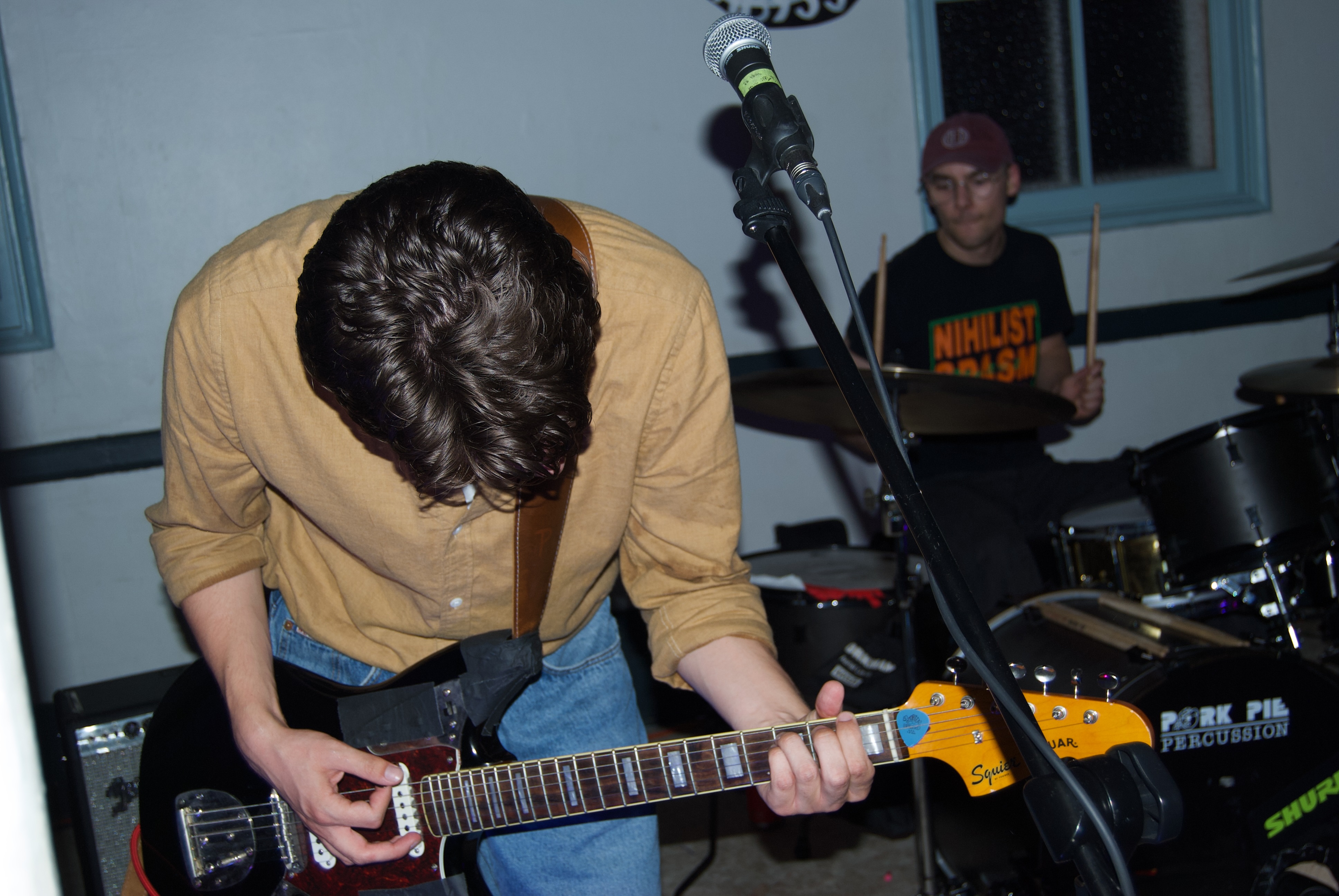
Photos by Shayla Little Maclean. View the whole photo gallery here.
Medieval Found Footage’s Abagnale is here, and it feels like the talk of the town across southern Ontario. The London, Ontario four-piece have spent the past five years growing into their own unique sound, and the culmination of all those years of work is a triumph of an album. I can give you an idea of Abagnale by repeating that it’s suited to fans of Spiderland and early Black Country, New Road—but beyond that, Abagnale is a release that feels difficult to pinpoint, just as any trailblazing effort often is. In being introduced to Abagnale via the spastic, vulnerable, and unhinged opening of “Diluted,” the maturity we in “Shark / Eats / Man” is almost unprecedented. The album explores themes such as loss, urban degradation, and denial in a manner that is so honest and raw that each song feels like confronting an exposed nerve ending. Abagnale tears deep into concepts of the self and grasps for the truths that feel painful to confront, in a release that showcases some of the best noise rock that southern Ontario has to offer.
Medieval Found Footage comprises high school friends and founding members Kadin Fehr (vocals, guitar), Oliver Clarke (guitar), and Brooke Sandwith (bass), with JJ Sorensen (drums) being a new addition to the lineup. Fehr scouted Sorensen for the band at a vintage camera show 2024 after the departure of their original drummer. I met up with the band during their album release weekend in the quietest room we could find at tonight’s venue: a church in Hamilton, Ontario. Amongst the bookshelves they locate an illustrated bible; the first page Fehr flips to touts verses about swapping wives. We chuckle at its absurdity, but sadly, we don’t have the time to read all about the sacred topic. The Eucharist Church wifeswap bible is promptly reshelved.
Originating in St. Thomas, Ontario, and now primarily based in London, Ontario, the band operate as part of a music scene with a rich history and a dedicated community. Sorensen describes it as “a very fertile community right now, for its size, and just the right kind of enthusiastic people in the right place at the right time.” Sorensen sits on the Eucharist Church couch shoulder-to-shoulder with his bandmates, sporting a Nihilism Spasm Band t-shirt. I arrived at this interview believing that the saying I kept hearing repeated in local circles, that “London, Ontario is the noise rock capital of the world,” was a statement that was solely based on the currently-existing rich noise scene present in the city. While it’s true that London punches far above its weight when it comes to its noise output, locals Nihilist Spasm Band are largely recognized as the first noise band to exist. I took Sorensen’s word as a homework assignment, and you should consider doing the same: “There’s a great filmmaker in London named Adriana [Jiménez], who made a very good, very matter-of-fact mini-documentary about the history of noise, interviewing some of the surviving members of Nihilist Spasm Band, and some current artists, too. I think it’s called “When in London Listen To Noise,” right? It’s fantastic. Check that out for sure. That’ll tell the story better than I ever could.” The precedent for good noise in London was set a long time ago, and it continues on over 50 years later.

So what is Abagnale? The word, in itself, is rather pleasant to the ear (pronounced ab-ag-nail, similar to the name “Abigail”), but may or may not hold negative connotations in your mind depending on your familiarity with infamous American con-man and writer of Catch Me If You Can, Frank Abagnale.
Kadin Fehr: Who is Frank Abagnale? Like the shittiest guy ever. It just felt, spiritually, like every single narrator in all the songs feels possessed by Frank Abagnale. Well, not all of them, but what I think is interesting about Frank Abagnale is that his career was solely touring around universities and doing speeches. Because he lied about everything, right? Like, he lied about lying. So I think he’s such a pathetic guy. That’s why in “Two Lefts” there’s the lyric: “My Frank Abagnale tour across America.” It’s like the saddest thing ever! This guy just drives around all day telling stories of things he never did. The one thing he really did was sexually assault some girls on a school campus claiming he was a doctor. That he had to give them breast exams or something. Like, he’s a shitty guy. He’s a really bad guy. So that’s the name…He also just sounds pretty. If you don’t know what Abagnale means, it’s just like: “Abagnale…” It’s a good word, right? I’m big on good words that have awful [meanings]… like, I nicknamed my dog Roach. I thought it just sounds kind of beautiful, if you don’t know that it’s a bug. It’s kind of French-sounding. Roach…
JJ Sorensen: It’s like that Replacements album, Tim. It’s like, “Who’s Tim? What does it all mean?” And Paul Westerberg just said, “I just thought it was a really beautiful name, Tim. Just a good name, good word.”
KF: To all the Tims out there: your name is beautiful.
OC: I have an uncle Tim. Shoutout uncle Tim, from Ingersoll.
…
Our first encounter with an Abagnale-esque character is in the opening track, “Diluted.” A song primarily exploring themes of denial, its content feels so personal that I sometimes feel perverse in listening to it. The lyrics plead to “stop it/stop the song,” a vicious lambasting directed inwards towards the self, and a total, almost infantile breakdown are just a few notable elements of this nine-minute opener. Examining the turmoil involved in concealing or coping with deep-seated truths, “Diluted” is ultimately about “a guy losing a fight with his own mind in an attempt to ignore his own darkest thoughts or insecurities,” according to Fehr. In a Cartesian sort of duality, the inner monologue has “divorced itself from his personality and become its own agent, making it impossible for him to ignore any longer.” “Diluted” showcases, in all its ugliness, the regressive and consuming state of being that arises when man is effectively alienated from his own self and denies his true nature.
The song lays everything out in the open, allowing the prospective listener to peer in and bear witness to these inner machinations of the self. Alongside these themes, we’re presented with an overwhelming cacophony of sound, or otherwise a painful, haunting silence studded with screams and commands uttered through gritted teeth. “Diluted” might either fill your voyeuristic curiosity or frighten you away entirely, effectively acting as a litmus test for whomever might want to indulge in Abagnale. Fehr says: “We decided we’re gonna put it like we do in real life, as the opener, because we’re like, ‘if you can make it through this song, you get to unlock the rest of the album.’” Unfortunately, if you can’t appreciate Medieval Found Footage at “Diluted,” then you don’t deserve them from “Greeter” onwards.

Abagnale has been a long time coming. Medieval Found Footage originated in 2022 while the members were in high school, operating as a cover band before eventually starting to write their own songs in December of 2023. Though they were originally influenced by bands like Modest Mouse and Have a Nice Life, today the members of the band have some widely different tastes amongst themselves—While Clarke likes death metal and screamo, Fehr doesn’t see eye-to-eye and will listen to Chet Baker instead. Sandwith has a penchant for electronic music and plays synth on songs like “Two Lefts,” and Sorensen is fond of Touch and Go noise acts like The Jesus Lizard.
“Spokane, WA” is the only song on Abagnale written with Sorensen as a part of the lineup, while songs like “Greeter” have been on their setlist since their high school graduation gig in 2022. Medieval Found Footage have spent the past few years scattered apart from each other, fighting to find the time to write music and play live shows in between their busy school schedules all while living in different cities. With all of this time to grow and change as people and as musicians, most of the songs on Abagnale have undergone some sort of evolution, and the band feels like they’ve discovered their own songs through the act of live performance.
Brooke Sandwith: I think a lot of the songs became less derivative [over time]. Each song you can kind of attribute to want[ing] to do something similar to something that an artist we were listening to at the time was doing. But through the years of refining the material and playing it live, we ended up kind of finding our own voice through it. I’m glad we waited to record it, because we found our voice through the songs that we had already written and it was cool to go through that process.
KF: Yeah, we’re definitely a live band. I think a lot of the songs have changed a lot just from us playing them live and finding a good energy where we’re comfortable playing them. There was a lot of awkwardness in the early days that I think is completely kind of oiled out now.
A handful of older songs didn’t make the cut for Abagnale. One of their first original songs, “Zios,” is immortalized on the “Song for a Siren” lyric: “We sang with Zios all night long.” The tracks “Pete’s Christmas” and “Home Alone” might one day be found on an extra festive Medieval Found Footage single. Fingers crossed!

The covers for Abagnale and for the releases of their singles, “Spokane, WA” and “Renovation,” are all visibly weathered by age, or depict something actively crumbling and deteriorated. An encompassing theme within Abagnale is that of urban decay, inspired by the band’s upbringing in Ontario towns which feel stuck in time or are decaying before their eyes.
KF: I think that the lyrics [talk] about a kind of rotten postmodern state of the world, where all the infrastructure, everything around only ever feels like it’s going backwards. And I think the lyrics reflect that most of the time. Some songs, maybe, are a bit more fantastical than that, but I think at the end of the day, a lot of it is about the idea of living in an entire nation that sort of feels like it’s slowly going back in time.
JS: Yeah, all the mid-century modern homes are just crumbling. They’re just falling apart.
Oliver Clarke: I took the photo for the “Spokane” cover. That’s [a wall decoration at] an old Blockbuster in Owen Sound, where I grew up. […] It’s been shuttered for 15 years. It was one of the last open ones in Canada. I remember going there as a kid in like 2007, and it’s still standing, but it’s just absolutely falling apart. Owen Sound is kind of a community that’s falling apart in a lot of ways. It hasn’t grown since 1980, and a lot of those old buildings are crumbling. So that just kind of reflected growing up, and the album art reflects my life and all of our lives in that way.
KF: We grew up in St. Thomas, Ontario, [with the exception of JJ growing up in Ingersoll, Ontario] so this is kind of the environment in which the songs were produced. And even London, to some extent, is under permanent construction. Like, you try to drive around London right now, and it’s just awful. It feels like nothing ever gets done, which I know is the same with any small town place in Canada.
…
What’s going on in the case of “Spokane, WA”? I was anticipating hearing some sort of real-life tale about a tragic situation involving a little girl and a river, but this one is all fiction, thankfully. In deciding what they should name the song, inspiration can truly come from anywhere in our modern-age:
KF: I didn’t know what minor kind of American cities had a river that you could drown in. So “Kalamazoo” was the original name, and I didn’t like that. Then I saw a TikTok–you remember that thing where people were like, “I’m so hungry I could eat…” and they say some random Facebook friends that [the person being recorded] had? Someone was doing that to her boyfriend, and then the guy turns over and looks at her and says: “My friend from the rowing team who drowned in the Spokane River in 2009?” and I thought that was so funny. [So] we picked that, but we made sure to do our research. No little girl or child under 14, for that matter, has drowned in that river, that I know of. So we’re not gonna have any grieving parents saying that we’re profiting off of their tragedy. I really didn’t want that to be the case.
OC: Don’t go drowning in the Spokane River now. It would really tarnish the song.
KF: Yeah, our song’s a bit of a PSA, like just stay clear of that area, you know.
Before the band headed out to record Abagnale this past January, they were already a few attempts deep on recording their music, but it never ended up as something they were satisfied enough with to release. It became the case that they were itching to have a recording they were proud of. Their first released song was “Greeter,” which was their only song available on streaming for the better part of three years. The jump in quality we can hear from Abagnale’s recording of the song is unmistakable—everything feels perfectly balanced, with every instrument sounding about ten times fuller than it did previously. In order to get the ball rolling on recording the album, “You just set a day, because these things don’t happen if you don’t. So you pick a day, and then, ‘Alright, that’s it, it’s gonna happen in January.’” Sorensen tells me.

Abagnale was recorded with Ben Miles and Gregory Lang at Drift Studios in Goderich, Ontario, where Fehr tells me that the two worked as a “really fantastic, synchronous unit.” The decision to get Miles to produce their record was sparked by his work on Public Health’s debut record, Minamata, which was released last summer. Sorensen explains that “The moment I heard the first Public Health song, I knew right away that it was a very honest recording, and that we’d be in good hands with someone like that.”
Ben Miles tells me (in an earlier interview I conducted with Public Health about a month after the recording of Abagnale) that a sonic aesthetic he leans into is by making a band “sound like how they really are.” In his words: “With Medieval Found Footage, that’s a great band! And the album is gonna sound really good, because they’re just so good.” With a synergistic nature running through the band and their producer, it’s no surprise Abagnale is a fantastic sounding record.
OC: [Ben’s] input was great, and I think it shows. He was great to work with. Wasn’t overbearing, but wasn’t underbearing either. He was a perfect amount of bearing. He would give minor inputs on things he thought could improve the recording, and those small things added so much.
KF: A lot of the overdubs in various songs were invented on the spot, in-studio, and, as you can expect with a band, not everyone always agrees on if it should be in the song or how loud. A lot of those little details are really only there because either Greg or Ben swayed the room to keep them. There would be no Abagnale-glitching in “Diluted*” nor Mechanical Birds in the “Shark / Eats / Man” finale without those two!
*A sample of Frank Abagnale’s voice can be heard towards the end of the song “Diluted”
JS: On January 1st is when we went in the studio, and you just [rehearse] until you’re ready, and you just go. […] We essentially rehearsed that record in four days and just went in and played it in two days. […] It was pretty good, pretty efficient. Ben is the man for that kind of stuff.”
KF: Yeah, I mean, we tracked an album in like pretty much two days, so if that says anything about how his work ethic is just very easy going and… very little roadblocks, you know what I mean? And when we did lots of fun stuff, like on “Spokane, WA” we wanted the guitar to sound a little bit distorted, but kind of in the way that a microphone compresses, not in the way a pedal does. So we ran the microphone feed through a preamp, and that’s why it sounds totally destroyed.
…
Sending off Abagnale, “Shark / Eats / Man” significantly slows in tempo from the first half of the album, in what Fehr describes as the most personal song on this release. Sometimes I can’t help getting a bit choked up at it.
KF: Speaking on that ending, I think it was in a sense designed as a sentimental thing. [The song] originated with our old drummer, and so when we were playing it back, it was, for me at least, a very beautiful kind of send off to the band as it was. Because we didn’t know if we’d find another drummer, or if the band would end with just that recording. So to me that part has always felt very reminiscent of… I don’t know if you know the New York 1981 show that New Order played. They played the show only a couple of months after Ian Curtis killed himself, when they end that show with “Temptation”… at the end of it, they all take turns placing down their instruments, leaving the song, and walking off stage. By the end, there’s no one on stage, and it feels very beautiful. And so I think that was a bit of an inspiration, at least on my end, for how we end the song, is to have everyone give their last piece, you know? I play a little solo, and then I put my guitar down, then Oliver puts his guitar down, then Brooke puts her bass down, and then it’s just the drums again, kind of like a snow globe–starts with the drums, ends with the drums, in a sense.
BS: “Shark / Eats / Man” ends on a six minute instrumental, and it almost feels like the most honest thing on the whole record. Like after everything that’s been said, it’s just four people playing instruments in a room, and I feel like there’s some sort of statement to be made there about like… I can’t exactly get to the root of it, you know.

Now, with the record all said and done, there lies a sense of relief within the band. In a way, Medieval Found Footage are happy to part with the old and embrace what comes next.
KF: We’ve been playing these songs for so long, you know. I mean, to be a bit of a historian of the band that I’m in, we’ve been playing “Greeter” for four years, and most of these other songs for three years. […] To us, we love the songs, but we’re ready to write new stuff.
OC: […] Having played songs you wrote in high school, it’s like.. I don’t know, I’m just kind of sick of some of them. So I’m happy to move on.
KF: It’s good to give [the songs] to everyone else, so they’re no longer just ours. You know what I mean?
…
The sappiest part of interviewing Medieval Found Footage was finding out what, at the end of the day, is their favourite part of being in this band.
KF: My favorite part of being in Medieval Found Footage is that I get to play with three talented musicians. I am definitely the least technically competent member of the band, so sometimes I feel like I’m being anchored heavily by these three, like they’re like the only reason that we’ve got any of this. I’m very grateful for the people that are in this room today.
JM: Getting to watch [Kadin] is the best part about being in this band, getting a front row seat to Kadin’s madness. That’s it.
OC: I just love getting in the studio, throwing something that I think sounds cool together, and other people getting to hear it. I mean, I would be playing live if there were zero people at our shows, so the fact there’s, you know, 15, 20, 30, 100, that’s just an added benefit to it. It’s fun. I don’t know, playing music is fun. I think everyone should do it. If you’re thinking about forming a band, go do it, please. We need more bands that are making noise rock. And we get to play with a lot of amazing bands.
BS: It’s great playing in a room with people that you’re on such a creative wavelength with, and it’s been so great saying that I can actually be a fan of the thing that I’m making. You know, I like to consider myself a fan of MFF just because I admire the work that everyone does in this band so much, and it’s something that I can be proud of.
KF: On Oliver’s last point–I mean, me and Jack [Yanover] were just talking about it yesterday, but it’s just so cool having kind of naturally sprung up in like this quickly developing scene. None of us were like, “Oh, let’s jump in on the Southwest Ontario hype right now,” it just has kind of shown up, and we just were lucky enough to find ourselves surrounded by a ton of like-minded people who, in the same time, about three years ago, started playing cool experimental stuff. So being able to kind of have all these cool contemporaries and hold your own is very cool.
The Eucharist Church in Hamilton has a back hall with great acoustics and little ventilation, where Medieval Found Footage would play their album front to back. They play hard. The set finishes with Clarke collapsing on the ground and Fehr sweating through his dress shirt as Sandwith’s bassline carries on steadily. I stand in awe as they bring me closer to God, and when all is said and done, Sorensen plays the final notes of Abagnale all by his lonesome.
Catch Medieval Found Footage at their upcoming performance at Gregfest in Goderich, Ontario, and listen to them on Bandcamp or Spotify.


Leave a Reply